Get Full Government Meeting Transcripts, Videos, & Alerts Forever!
Get email alerts on the Long Term Care Reimbursement topic
No spam. Unsubscribe anytime.
Nursing-home groups press Senate to fix PDPM conversion after proposed Medicaid change would cut payments
Summary
LeadingAge Ohio and provider groups told the Senate Finance Committee a technical omission in proposed Medicaid language would shift case-mix measurement from RUGS to PDPM and effectively cut many nursing-home reimbursements unless a statutory conversion factor is added now.
LeadingAge Ohio and other long-term care advocates urged the Ohio Senate Finance Committee on Wednesday to restore a technical fix to the Medicaid reimbursement language in the budget after they said a shift from the RUGS case-mix system to PDPM would produce large, unintended cuts for nursing facilities.
The organizations told senators the change was likely an omission in the budget text, not an intentional reduction, and that state law currently pins many reimbursement details in the Ohio Revised Code, limiting the Department of Medicaid’s ability to make an administrative fix.
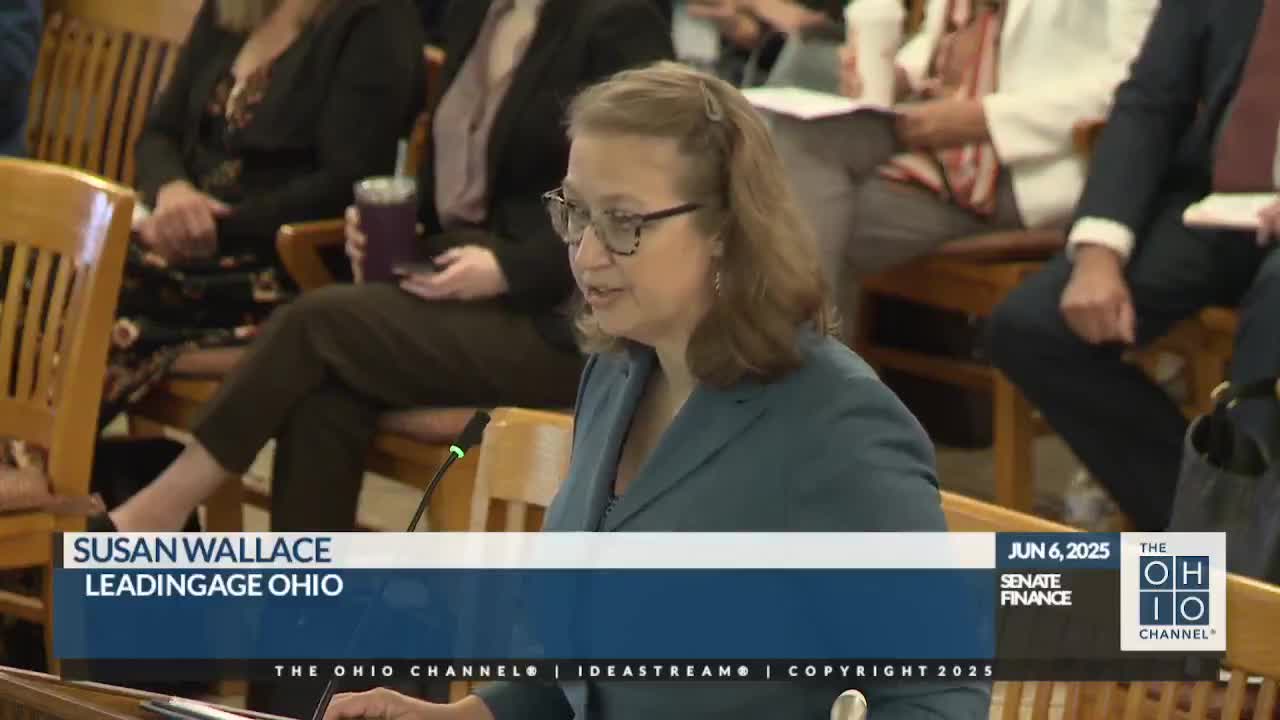
"It would be about $70 on average, across the state, to nursing homes," Susan Wallace, representing LeadingAge Ohio, told the committee, describing how the conversion would lower per-resident payments unless a conversion multiplier was adopted. "We think that it was an omission…this is a change that would be in the hundreds of millions of dollars."
Why it matters: The shift from the RUGS (Resource Utilization Groups) measurement to PDPM (Patient-Driven Payment Model) changes how resident care intensity is scored for payment. LeadingAge Ohio said the average RUGS case-mix score statewide is about 3, while PDPM currently yields an average nursing score of 1.4 — requiring a roughly 2x conversion factor to avoid steep cuts.
LeadingAge Ohio asked the legislature to adopt language (amendment SC 2858) that would require the Department of Medicaid to develop a conversion factor so that payments remain effectively budget-neutral for facilities. The group said an immediate statutory fix is necessary because many nursing-facility reimbursement rules are written into statute rather than administrative rule, reducing the division’s discretion.
Senators pressed for detail on alternatives, including a phased PDPM transition, stop-loss/stop-gain protections and whether the Department could correct the problem by rule. Wallace said the Department had proposed a gradual transition in prior analysis but that the statutory silence creates legal and practical uncertainty and the conversion is best addressed in the omnibus amendment now.
Providers also urged a blended approach to scoring that would weight nursing care most heavily but retain other clinical measures (speech-language pathology and non-therapy ancillary components) to better capture dementia and complex care needs.
Discussion vs. decisions: Committee members raised many technical questions but took no formal vote. Witnesses provided amendment numbers and urged that the language be included in the final omnibus package to prevent immediate reductions in facility revenue.
Ending: Advocates said the conversion is time-sensitive because PDPM implementation is already happening nationally and in measurement data. They asked senators to adopt the technical fix in the budget so providers avoid sudden reimbursement swings while longer-term rate-setting can proceed.