
Plymouth Planning Board sets 2025 priorities; debates commercial uses in Ag zone and excavation rules
Get AI-powered insights, summaries, and transcripts
Subscribe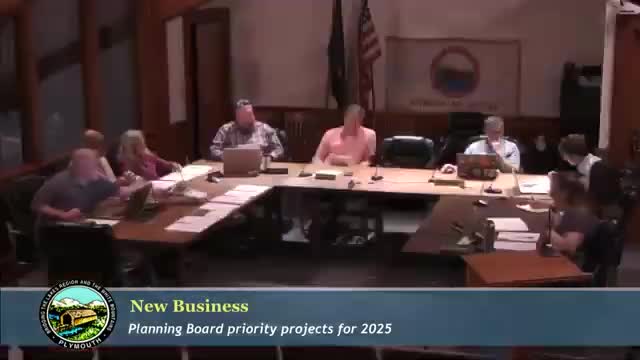
Summary
The board ranked its workplan—Tenney Mountain overlay first, Fairgrounds overlay second, commercial‑use rules in the agricultural zone third and earth‑excavation regulations fourth—and debated whether to tighten special‑exception criteria for Ag‑zone commercial uses and home occupations.
The Planning Board finalized a prioritized list of planning projects for 2025 and spent substantial time debating how to handle commercial uses and scale in the town’s agricultural zone.
By consensus, the board’s top four priorities for the year are: (1) Tenney Mountain Overlay District; (2) Fairgrounds Road Residential Overlay District; (3) review of commercial uses in the agricultural (Ag) zone, including home‑occupation rules and special‑exception criteria; and (4) consideration of earth excavation regulations (RSA 155‑E).
Members said the Fairgrounds Road overlay is a pragmatic second priority because prior work left a draft close to deliverable and the area has existing water and sewer infrastructure. The board discussed redrawing base‑maps and updating ICD boundaries where appropriate.
Commercial uses in the Ag zone prompted the most debate. Some members argued that allowing a broader array of small, scaled businesses — or clarifying home‑occupation rules to permit accessory‑building uses and a modest number of on‑site employees — would support economic opportunity and local job growth. Others cautioned that increased commercial activity can compete with land that might be used for housing and urged sharper special‑exception criteria to preserve the Ag zone’s character.
Board members discussed several regulatory approaches to control size and scale: creating square‑foot thresholds in the use table; adopting floor‑area‑ratio rules or tighter lot‑coverage controls; applying form‑based or design standards for specific corridors; and sharpening special‑exception criteria used by the Zoning Board of Adjustment. The board asked staff to consult with the Zoning Board about how special exceptions are working in practice and to return recommendations for clearer, more objective criteria.
On earth excavation (RSA 155‑E), staff explained the statute’s special‑exception framework and the four criteria the Zoning Board must find when the town has not adopted local excavation regulations. Joseph read the statutory criteria and summarized them for the board, noting that local regulations can be adopted to provide clearer local standards. He quoted the statute’s language listing concerns the ZBA must consider, including property values, highway impacts, nuisance or health and safety hazards, and compliance with other local special‑exception criteria.
Action and next steps: the board confirmed priorities by consensus and assigned staff tasks: produce a compare‑and‑contrast memo for the Tenney Mountain overlay, prepare an outreach and education synopsis for the Fairgrounds Road overlay, draft suggested changes to special‑exception criteria and home‑occupation language in the Ag zone, and produce a primer on RSA 155‑E with local regulatory options for earth excavation.
No new local ordinance was adopted at the meeting. The board framed the outcomes as staff directions and prioritized follow‑up research and stakeholder outreach.