
Council adopts overt video‑monitoring pilot with privacy guardrails after committee amendment
Get AI-powered insights, summaries, and transcripts
Subscribe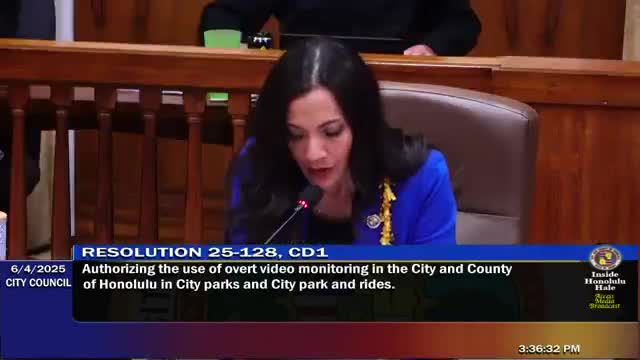
Summary
The council adopted a measure authorizing overt video monitoring in city parks and park-and‑ride lots, and amended the resolution to specify that cameras must not face private property. Supporters said monitoring will deter vandalism and drug activity in parks; opponents raised immigrant‑community privacy concerns.
The council adopted Resolution 25‑128 (CD1 FD1) authorizing overt video monitoring in city parks and park-and‑ride facilities, and amended the proposal to add a privacy safeguard that monitoring devices must not face private property.
Council member Okimoto introduced the measure on behalf of the public‑safety committee. Council member Cordero moved an amendment to the posted FD1 clarifying that overt video monitoring "must not face private property," and members approved the amendment. Council member Tupelo described the pilot as a way to deter crime and support enforcement in parks that have reduced police presence, saying the technology could help "restore a sense of safety in high risk areas."
Testimony included opposition from residents concerned about surveillance and specific effects on immigrant communities. Natalie Wasa told the council she opposed the measure, citing concerns that "immigrants and legal nationals" are particularly sensitive to video monitoring and that crime could shift to adjacent locations. Community members who supported monitoring said targeted, overt cameras provide evidence for enforcement and can be limited by strict placement and data‑use rules.
With the posted FD1 amendment—restating the requirement that cameras not face private property—the council adopted the resolution and directed the administration to proceed with pilot deployments consistent with the approved restrictions.
The council asked the administration to report back on pilot outcomes and to include safeguards on placement, notice to the public, and data governance. Council members said they expect follow‑up reporting during implementation.