
Council hears push for police-dispatch broadcasts as HPD and telecom experts warn of legal, safety limits
Get AI-powered insights, summaries, and transcripts
Subscribe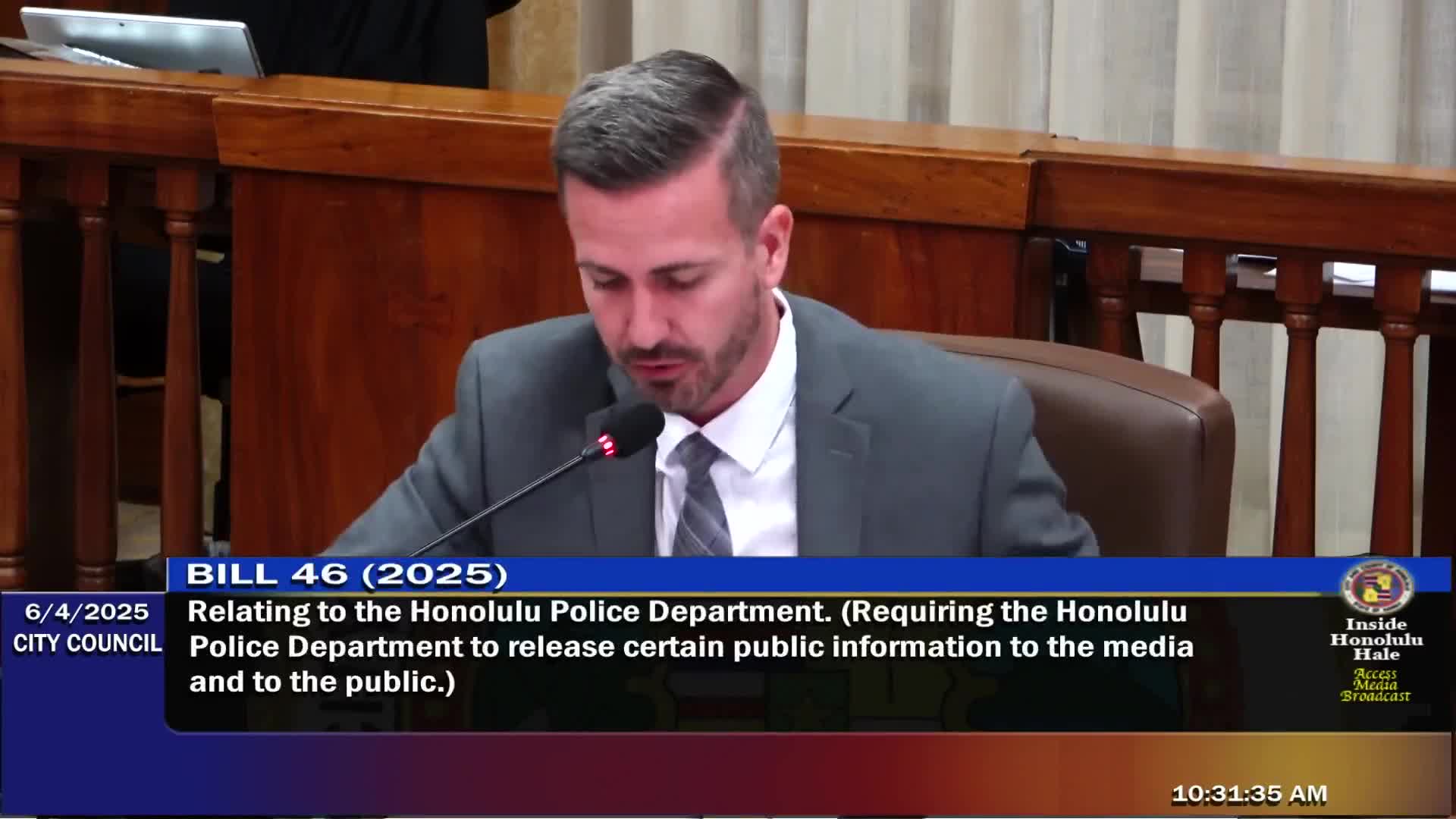
Summary
Honolulu City Council members took extended testimony and debate on Bill 46, which would expand media access to Honolulu Police Department dispatch communications, with supporters urging transparency and HPD and telecom experts citing federal CJIS and safety limits.
Honolulu City Council members took extended testimony and discussion on Bill 46 — a proposal to require broader media access to Honolulu Police Department (HPD) dispatch communications — weighing calls for transparency against federal-security and officer-safety constraints.
Supporters of the bill said greater access would improve public information during urgent incidents and strengthen accountability. Citizen and neighborhood-board speakers urged the council not to curtail a free press and to consider the role of modern media and social platforms in public safety.
Telecommunications specialist Roy Kuroda, who identified himself as working in telecommunications with HPD, told the council that federal and operational rules constrain what can be released. “The FBI’s criminal justice information system, CJIS, security set strict standards for how criminal justice information, CJI, can be accessed and shared,” he said. “Delaying a broadcast is not the same as redacted if the audio contains CJI, even if delayed, it remains non compliant under CJIS.”
HPD leadership acknowledged the public demand for information while stressing officer safety and investigatory integrity. A department representative said the department is “committed to transparency but not at the expense of officer investigations, integrity, or [the] privacy of victims or witnesses,” and later urged a collaborative process: “I think we need to at least make a commitment to bring the right people to the table, figure out what we can do.”
Council members pressed for a middle ground. Several members said they want more information flow to the public but recognized HPD’s point that live or unredacted feeds can reveal sensitive personally identifiable information and tactical details. Some members also asked whether a delayed or filtered feed could meet both transparency and legal-security requirements.
No final substantive ordinance text or implementation detail was adopted in the session. The council took the bill through a reading (the reading items on pages 7–8 moved forward with recorded reservations noted by several council members) and left substantial drafting and operational questions for follow-up. HPD pledged to meet with council staff and the bill’s introducer to explore solutions that could balance transparency and legal/security constraints.
The testimony and discussion highlighted two competing priorities: public access to information during unfolding incidents and the CJIS/HIPAA and operational protections that limit broadcast and reuse of dispatch audio. Council members and HPD agreed to continue discussions before the measure returns for further action.
The council also recorded formal reservations by several members on the related reading items; no final vote on the operational details of Bill 46 occurred during the meeting.