Get Full Government Meeting Transcripts, Videos, & Alerts Forever!
Get email alerts on the Solar Projects topic
No spam. Unsubscribe anytime.
Developers present 20 MW White solar and 8 MW storage proposal; town-hall, planning review next
Summary
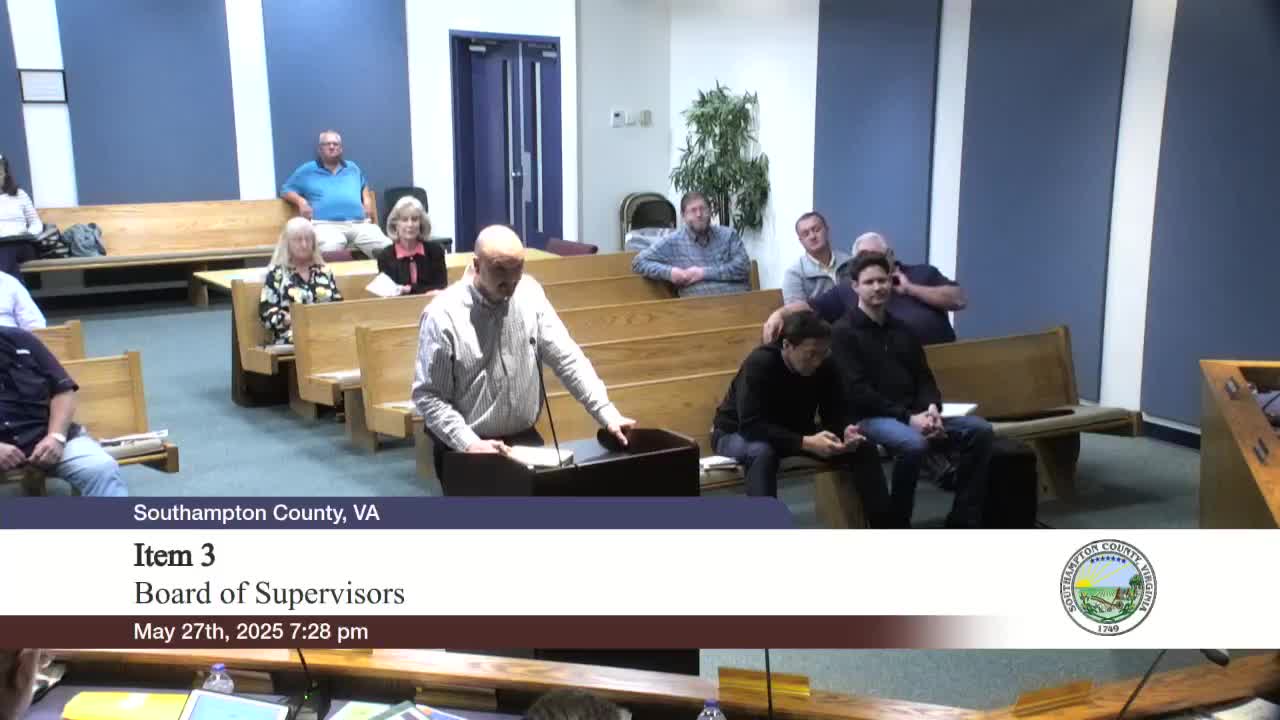
Synergy Power presented a proposed 20-megawatt solar array with an 8-megawatt, four-hour battery near General Thomas Highway; the board opened a public hearing but took no vote.
Synergy Power representatives on Tuesday outlined the White Solar and Storage Project, a proposed 20-megawatt photovoltaic array with an 8-megawatt battery (4-hour duration) sited on roughly 100 acres set back about 1,700 feet from General Thomas Highway.
The developers said the project already has a pathway to interconnect with Dominion Energy and would be paired with a power purchase agreement. "We really believe the stars are aligned for this project," said Bill Pham, a Synergy principal, describing a $1.6 million package of local economic benefits including $800,000 upfront (with additional payments at permit and commercial operation), and stipends to local volunteer fire and rescue squads.
The Planning Commission and the board will consider the project in coming steps; the board opened a public hearing and did not take action Tuesday. The county staff said the application must complete required public input, a town-hall meeting and planning review before any final county decision.
Why it matters: the proposal is among the largest private renewable projects publicly discussed in the county this year and would produce tax and direct-pay benefits while triggering long-term land-use and public-safety questions.
Developers offered technical and financial details and fielded questions from residents and tribal representatives. Kevin Osborne, a Synergy project developer, described the site as sandy land of low agricultural productivity and noted screening by existing trees. He told the board the system would be set back, not visible from nearby highways and that Dominion had capacity for the interconnection because of nearby generation capacity. "This property has poor soil, and is not conducive to agricultural use," Osborne said.
Residents raised several concerns. A number of speakers sought clarity about ownership and long-term site management: whether the land would be purchased or leased and what would happen at the end of the project's life. Synergy said the landowner had options but that the company will post a decommissioning bond to cover removal if the project is not repowered or abandoned. Synergy described the bond as a financial assurance from an investment-grade insurer; the company also said repowering is the likely choice after decades of operation.
Tribal representatives asked that cultural-resource surveys precede any ground-disturbing work. "We would call for a cultural resource study, shovel and pit tests," said Leroy Hardy of the Nottoway tribal community, urging early review because the area lies within a sensitive river corridor.
Fire and emergency responders' training and battery-safety questions were also raised. Residents recalled high-profile lithium-ion battery incidents elsewhere and asked how local volunteer departments would respond. Synergy said battery chemistry choices and built-in suppression features reduce thermal-runaway risk and that the company would provide training and equipment stipends to local squads; the company proposed a $120,000 distribution across 12 volunteer departments ($10,000 each) as part of community benefits.
Developers and several residents also discussed reliability and grid impacts. Synergy emphasized that paired storage can stabilize intermittent generation by charging during surplus and discharging during peak demand; Dominion's selection process favors projects that include storage capacity.
Next steps: the board did not vote on the project Tuesday. The developers were asked to hold a town-hall meeting, then the planning commission will schedule a formal review before the matter returns to the board for final action. The board repeatedly reminded speakers that the county's solar ordinance sets siting rules and screening requirements that any project must meet.
Ending: County staff and the company said they would follow the town-hall and planning steps; tribal and neighborhood concerns flagged Tuesday — cultural surveys, decommissioning guarantees and local emergency planning — are likely to be part of the review record going forward.