Get Full Government Meeting Transcripts, Videos, & Alerts Forever!
Get email alerts on the Temporary Use Permits topic
No spam. Unsubscribe anytime.
Planning commission backs temporary rules to speed events and signs for fire‑affected Malibu businesses
Summary
The commission voted to recommend a temporary zone text amendment to city council that shortens temporary-use permit timelines, creates a tiered event system, allows limited temporary signage and calls for a staff evaluation before the end date.
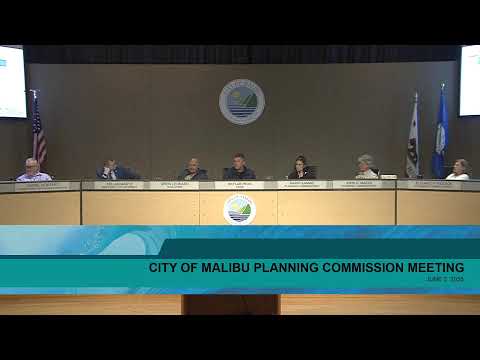
The Malibu Planning Commission on June 2 recommended that the City Council adopt a temporary zone text amendment to ease rules for temporary events and signage for businesses affected by the Palisades fire.
The staff proposal, and the commission’s recommendation, creates tiers for temporary events: gatherings of 99 attendees or fewer would require a planning clearance submitted at least two calendar days in advance and no mailed notice; events of 100 to 250 attendees would require a temporary use permit submitted at least seven calendar days in advance with five days’ mailed notice and be limited to 20 events per parcel per calendar year; events of 251 and above would follow existing TUP requirements (35‑day application, 32‑day notice). The commission also endorsed measures to limit one event per parcel per day during the temporary period.
Tyler Eaton, the planner who presented the amendment, said the changes were intended to give businesses a faster, lower‑burden pathway to hold community events while the city recovers from the Palisades fire. He said staff proposed the temporary rules apply through Jan. 31, 2026, with staff to present an evaluation to the council before that expiration; the commission endorsed that timeline.
Sign rules: The commission added temporary signage allowances to the proposal. Under the commission’s recommendation, temporary signs would be limited to 16 square feet each, non‑illuminated and without permanent foundations. The planning commission agreed that shopping centers, as defined in the retail ordinance, could have up to six temporary signs during the temporary period; other commercial parcels would be limited to two temporary signs. Commissioners confirmed signs must remain on the parcel (no off‑site arrow signs on public rights‑of‑way) and that property owners must authorize tenant signs.
Enforcement, public safety and review: Commissioners and public speakers pressed staff about enforcement and “bad actors.” The commission supported directing the city to make code‑enforcement staff available on weekends while the temporary program is in effect. Staff said existing enforcement tools (code‑enforcement actions, nuisance abatement and permit denial for repeat violations) would be used to deter noncompliance; the commission discussed but did not adopt a separate fine schedule in the hearing.
Public input: Business owners and property managers urged a longer temporary period to allow time to plan events and recover business activity; several asked the commission to permit the program through the 2025 holiday season or into 2026. Some requested flexibility to transfer event allowances across contiguous parcels under the same ownership; the commission left the limit tied to parcels in its recommendation, noting that multi‑parcel events that use common parking will be counted against each parcel involved.
Commission action: The planning commission voted to forward the ZTA to the City Council with the amendments above. Roll call was Vice Chair Leonard, yes; Chair Peake, yes; Commissioner Kamens, yes; Commissioner Mazza, no; Commissioner Riddick, yes. The motion carried.