
Wildfire Safety Advisory Board approves 2025 recommendations to Office of Energy Infrastructure Safety
Get AI-powered insights, summaries, and transcripts
Subscribe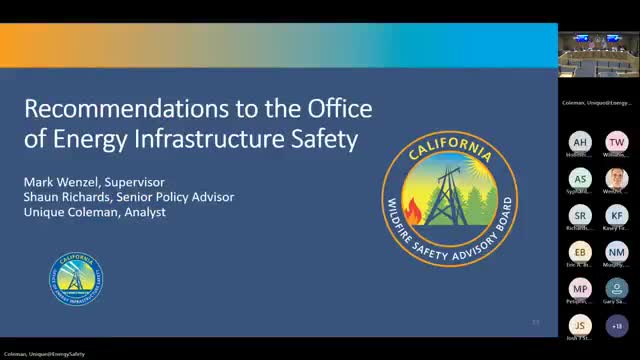
Summary
The Wildfire Safety Advisory Board voted unanimously June 4 to send its 2025 recommendations to the Office of Energy Infrastructure Safety, asking for clearer effectiveness tracking of mitigation measures and stricter standards around utility wildfire risk models.
The Wildfire Safety Advisory Board on June 4 approved its 2025 recommendations to the Office of Energy Infrastructure Safety (OEIS), asking utilities and regulators to improve how mitigation effectiveness and wildfire risk are measured.
Board members voted 7-0 to adopt the recommendations after staff presented an analysis of wildfire ignitions and utility reporting, and after the board debated standards for risk-modeling and data transparency. The board’s package asks for clearer annual tracking of mitigation effectiveness, standardized reporting units, and model-comparison requirements for utilities’ wildfire spread and consequence calculations.
Board staff said existing public datasets give useful signals but have limits. “The red books data … are only those that CAL FIRE responded to, within the state responsibility area,” staff analyst Unique said, noting that the dataset omits some federal and other local responses and can mix electrical ignitions from non-utility residential equipment. Unique summarized the staff finding: “There is no clear trend in ignitions and fires over time,” and cautioned that weather and reporting differences complicate long-term interpretation.
Staff and consultants reviewed multiple measures — Cal Fire incident reports, ignition reports submitted to Energy Safety, and utility before-and-after comparisons. They told the board that small sample sizes, multiple mitigations applied to single circuits, and inconsistent reporting units (for example, circuit miles versus number of trees) make it difficult to isolate the effect of individual measures.
The board’s recommendations focus on three technical areas: (1) require utilities to test and compare multiple wildfire-spread models — at least three, including one open-source, peer-reviewed model — and justify model selection; (2) ask utilities and Energy Safety to report full distributions from probabilistic simulations rather than single-point metrics and to report an appropriate number of significant figures that reflect model uncertainty; and (3) develop standard units and an annual tracking dashboard that shows the effects of mitigation measures across utilities.
Sean Richards, senior policy adviser, explained the rationale for reporting distributions: “Reporting a single value from a distribution of simulations is a representation of the risks. Effective decision making and oversight require a better understanding of the distribution of risk, and actually those tail risks.” He added a technical caution on numeric reporting: “Reporting to these levels misrepresents the level of uncertainty throughout the risk model process, and provides a false level of confidence in model results.”
Board member Seifert, an ecological and wildfire modeler, supported the recommendations to use multiple models despite the extra work: “Recommendations to add more models may sound like a whole lot of extra work, and it probably is,” she said, adding that different model types can produce substantially different outputs and that ensemble comparisons can reduce the risk of relying on a single, possibly misleading model.
The board also asked staff to continue developing methods for comparing mitigations (such as covered conductors, undergrounding, and enhanced vegetation management) using standardized metrics and to request follow-up studies that use before-and-after analyses tailored to similar-weather days. The recommendations note a recent econometric/machine-learning study that compared ignitions before and after mitigations by controlling for weather and estimating avoided ignitions and cost per avoided ignition; the board cited that work as an example of methods it expects to encourage.
Outcome and next steps: the board voted to transmit the recommendations to OEIS as presented. Staff said it will continue work on implementation details — including the model-comparison specification, unit standardization, and a public tracking approach — and will follow up with utilities and OEIS on timelines.
The board’s recommendation packet, staff responses to earlier public comments, and the final staff draft were published on May 23 and will accompany the transmitted recommendations to OEIS.
Less critical details: staff noted that several utilities’ recent WMP filings and decision dates are forthcoming (for example, PacifiCorp ratification scheduled for June 26), and that Energy Safety is evaluating petitions and change requests submitted in April and May.