Get Full Government Meeting Transcripts, Videos, & Alerts Forever!
Get email alerts on the River Crossing Bridge topic
No spam. Unsubscribe anytime.
Stafford supervisors signal preference for Option C in Rappahannock River crossing study amid grid and cost concerns
Summary
FAMPO staff presented a multi‑jurisdiction study of options to build a new Rappahannock River crossing west of Interstate 95 at the Stafford County Board of Supervisors meeting on May 27, 2025, and several supervisors signaled a preliminary preference for “Option C” while stressing the need to pair any bridge with surrounding road improvements and to resolve funding and environmental issues before construction.
FAMPO staff presented a multi‑jurisdiction study of options to build a new Rappahannock River crossing west of Interstate 95 at the Stafford County Board of Supervisors meeting on May 27, 2025, and several supervisors signaled a preliminary preference for “Option C” while stressing the need to pair any bridge with surrounding road improvements and to resolve funding and environmental issues before construction.
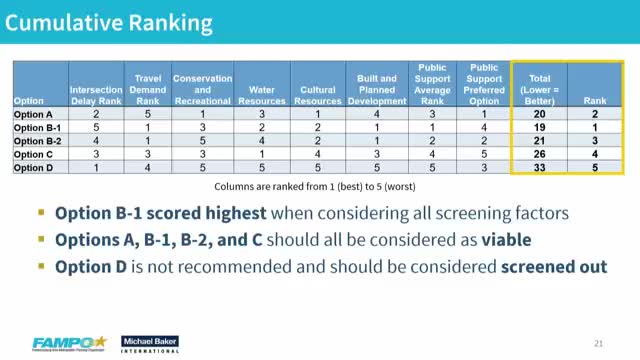
The study, begun after a 2022 east‑west mobility assessment, evaluates five broad corridor alternatives and aims to produce a locally preferred alternative that VDOT would later refine through the NEPA (National Environmental Policy Act) process. FAMPO staff said the study looks at travel‑demand data, environmental screening, public input and cumulative rankings prepared by consultant Michael Baker; the consultant’s top ranked choice was one of the B alternatives, but staff and advisory committees recommended A and C as implementable options.
Why it matters: there are few crossings west of I‑95, creating long detours when the interstate is blocked. FAMPO staff showed trip‑origin/destination data indicating heavy travel between Southern Stafford (north of U.S. 17) and Central Park/Spotsylvania/Fredericksburg. The study notes that roughly 40–41 miles of corridor exist without an adequate west‑of‑I‑95 crossing, and that a new crossing would add multimodal capacity, including a shared‑use path, transit access and an emergency responder route.
FAMPO staff member Ian, who led the presentation, summarized the history and purpose: “This is not the first time anybody's tried to find a route to cross the Rappahannock west of I‑95.” He told the board the process dates to earlier efforts in the 1990s and recommenced with the FAMPO 2022 mobility study and subsequent environmental linkage work awarded in October 2023. The project team is seeking a locally preferred corridor so VDOT can undertake detailed field work and NEPA engineering.
The options and the tradeoffs: the study evaluates alternatives labeled A, B1, B2, C and D. Staff said Option D was screened out because it would require widening Greenbank Road and would impact many nearby homes; the consultant recommended a B option in its cumulative score, but staff and the Citizens’ Transportation Advisory Committee (CTAC) advanced C (with a CTAC modification) and A as practical alternatives.
Staff identified a 250‑foot wide study corridor (to allow corridor shifts around wetlands and other constraints) while noting that the eventual roadway and shared path would occupy about 100 to 115 feet of that corridor. The presentation emphasized environmental and cultural resource screening, floodplains, wetlands, and existing easements as determinative factors in final alignment choice.
Public feedback and surveys influenced rankings but were geographically concentrated: staff said a March survey showed Stafford respondents tended to favor Option A while Fredericksburg respondents favored Option B; a later survey added a “no‑build” choice after concerns were raised. Supervisor Baumke cautioned that the initial survey did not include an explicit no‑build option, saying, “I think it's important to tell them that when we did the initial survey, we did not include a no build option.”
Board concerns focused on three themes: environmental risk and NEPA timing (B options intersect a large wetland and an environmental easement on the Fredericksburg side), local traffic redistribution (several supervisors said a new crossing will shift congestion into neighborhoods unless the surrounding grid is strengthened) and funding. Supervisor Mulkey and others pressed staff to show how corridor selection would pair with other projects such as a proposed Enon Connector and improvements on Garrisonville Road; staff noted a SmartScale application for the Enon Connector and described CenterPort/CentrePort Parkway as an underused, commercially oriented route that could be leveraged to support a new grid.
Staff offered implementation steps: once jurisdictions accept a locally preferred alternative, the consultant will produce a refined cost estimate and a VDOT‑led NEPA process would follow. Staff emphasized the corridor is intentionally broad and that VDOT engineers will adjust alignment based on on‑site soil and environmental findings.
No formal county vote was taken. Several supervisors publicly stated they supported Option C (or a C variant) during the discussion; Supervisor Gary said she prefers C and reiterated concerns about cost and proximity to existing neighborhoods. Chair Diggs asked whether the board would object to staff preparing a consent‑calendar resolution for Option C for the June meeting; staff closed the item saying no formal action would be taken at this meeting and that FAMPO plans to seek a policy‑committee corridor selection in June.
What’s next: staff said the consultant will prepare cost estimates and refined drawings for any locally preferred corridor and that VDOT will handle NEPA and on‑site engineering. The board and jurisdictions on FAMPO’s policy committee are expected to negotiate a single locally preferred corridor at the June FAMPO meeting to support future funding requests and NEPA work.
The record: the presentation and board discussion cited prior CTB (Commonwealth Transportation Board) activity on earlier crossing proposals, the environmental easement on the Fredericksburg side, and the consultant Michael Baker’s cumulative ranking; staff recommended moving A and C forward while screening out D.