Get Full Government Meeting Transcripts, Videos, & Alerts Forever!
Get email alerts on the Data Center Regulation topic
No spam. Unsubscribe anytime.
Residents urge pause as board refers data-center performance standards back to review
Summary
Public speakers raised environmental, noise, water and residential-impact concerns about proposed data centers; the board sent the county's Data Center Performance Standards back to the Planning Commission and established further review and an ad hoc committee to refine protections.
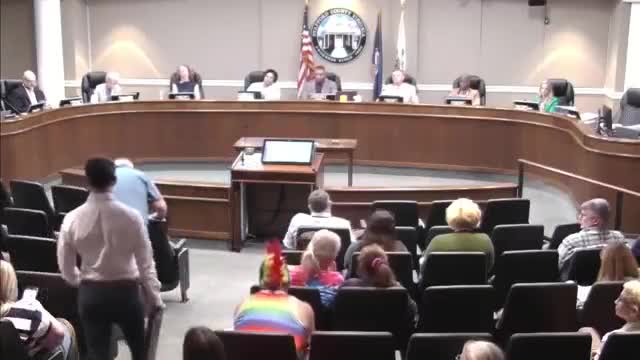
Residents from multiple districts urged the Stafford County Board of Supervisors on June 3 to slow or halt approvals for large data centers while the county revises its performance standards and studies environmental and residential impacts.
Public commenters cited a range of concerns including proximity of data centers to homes, potential noise — including low-frequency noise — impacts on wells and water supplies, increased strain on the electric grid, and long construction phases. Several speakers quoted the Joint Legislative Audit and Review Commission (JLARC) report and asked the county to place data centers in industrial zones rather than adjacent to residential neighborhoods.
Multiple speakers described the proposed data centers as “giant monoliths” with industrial-scale generators and 24/7 security lighting. Experts and residents urged the county to require environmental monitoring, sound modeling that includes low-frequency metrics (dBC), and to ensure developers do not remove tree buffers without county oversight. One resident reported that timber had recently been cleared near Kelsey Road and asked the board to inspect the site.
Supervisor and staff discussion acknowledged rapid changes in the data-center industry and the need to update local regulations. Board members repeatedly emphasized the county’s plan to reexamine the 2023 regulations: the board directed staff to return revised performance standards to the Planning Commission and supported the establishment of an ad hoc committee to study data-center siting and mitigation measures. Staff noted that many applications have already been submitted and that regulatory updates could affect pending and future cases.
Speakers pointed to examples from other Virginia localities: advisers from Loudoun and Prince William counties recommended locating centers in industrial areas and said localities there had learned to refine zoning after experience. Several commenters referenced news stories about data centers using supplementary generators or turbines when grid capacity is insufficient, and urged Stafford to anticipate technologies such as small modular reactors (SMRs) that utilities are reportedly considering for grid support.
The board’s direction will send standards back to the Planning Commission for further work; staff said that the Planning Commission’s subcommittee would meet publicly in the coming weeks to review proposed changes. Supervisors also discussed whether to “grandfather” projects already submitted; no final policy on grandfathering was adopted during the meeting.
The public comments and the board’s referral signal that Stafford intends to tighten or clarify standards on placement, buffers, noise limits, lighting and water or fuel use before allowing new large-scale data centers adjacent to residential areas.