Get Full Government Meeting Transcripts, Videos, & Alerts Forever!
Get email alerts on the Traffic Calming topic
No spam. Unsubscribe anytime.
Lewisburg delays traffic-calming studies, will collect fall data for Eighth Avenue and other streets
Summary
The Lewisburg mayor and council asked MTAS consultant Brad Peters to conduct targeted traffic counts and hold off on physical traffic-calming installations until fall when school traffic resumes; staff will compile a list of candidate streets for the study.
Lewisburg City leaders agreed to delay structural traffic-calming changes and to ask a Municipal Technical Advisory Service consultant to gather speed and volume data in the fall, when school traffic is in session.
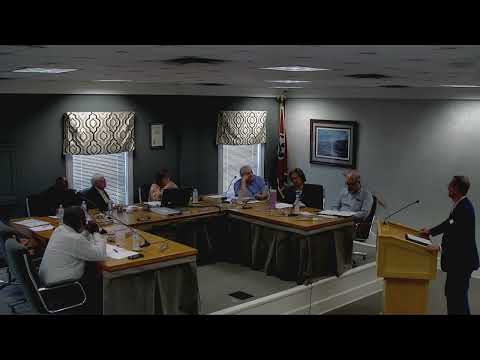
The decision follows a presentation from Brad Peters, a public works and engineering consultant with MTAS, who advised the council to base traffic-calming decisions on measured data rather than perception. “I typically leave them up a week,” Peters said of radar counters, recommending one-week counts timed with school sessions. The mayor and council asked staff to assemble the list of candidate streets — including Eighth Avenue (near Seager), Third Avenue North, Second Avenue at College Street, and the Ashwood/Taylor/Hall corridor — and to have police and staff coordinate timing with Peters.
Why it matters: Council members cited concerns about children and school buses on cut-through streets and wanted evidence before adding multiway stops or speed humps. Peters told the council that traffic engineers commonly use the 85th-percentile speed as a baseline and that many cities require that threshold be 5 to 10 mph over the posted limit before considering speed humps. He also explained the technical difference between speed bumps (narrow, parking-lot style) and speed humps (wider, intended to moderate rather than stop vehicle speed) and said removable preformed humps are an option for trial installation.
Most of the meeting's discussion focused on whether a four-way stop is an appropriate remedy. Peters cautioned that four-way stops are typically adopted based on volume and intersection-warrant formulas rather than as a general speed-control measure; they can be problematic at offset intersections and may increase low-speed collisions. “Typically, traffic engineers do not advise using four-way stops to slow traffic down,” Peters said. He recommended using measured volume counts to determine whether an intersection meets multiway-stop criteria.
Council direction and next steps: Council members agreed to delay any new studies until fall so data include school-related traffic. Staff (Gina and police leadership) were asked to email Peters the list of streets to be counted and to coordinate installation of radar counters. Peters said MTAS can perform targeted counts (not citywide) and will deliver a written report of vehicle volumes and speeds for each requested street. No formal vote was recorded; the council set the direction administratively and placed the request on the upcoming regular meeting agenda for finalization.
Background and options: Peters described alternatives beyond humps and stops — including chokers, curves and roundabouts — but noted cost differences. He also described common neighborhood policies used by many cities: requiring a neighborhood point of contact and a simple majority of signatures from affected residents before installing humps, because such measures generate neighborhood impacts (noise, localized nuisance). Peters said preformed humps can be trialed and later removed; permanent asphalt humps require proper markings and higher cost.
The council asked that the radar counts be timed for when school is in session and that the consultant coordinate with the police chief. Staff will return recommended study locations and the MTAS report to the council once counts are complete.