
Boulder planning board presses staff on permanence and flexibility of proposed TDM ordinance
Get AI-powered insights, summaries, and transcripts
Subscribe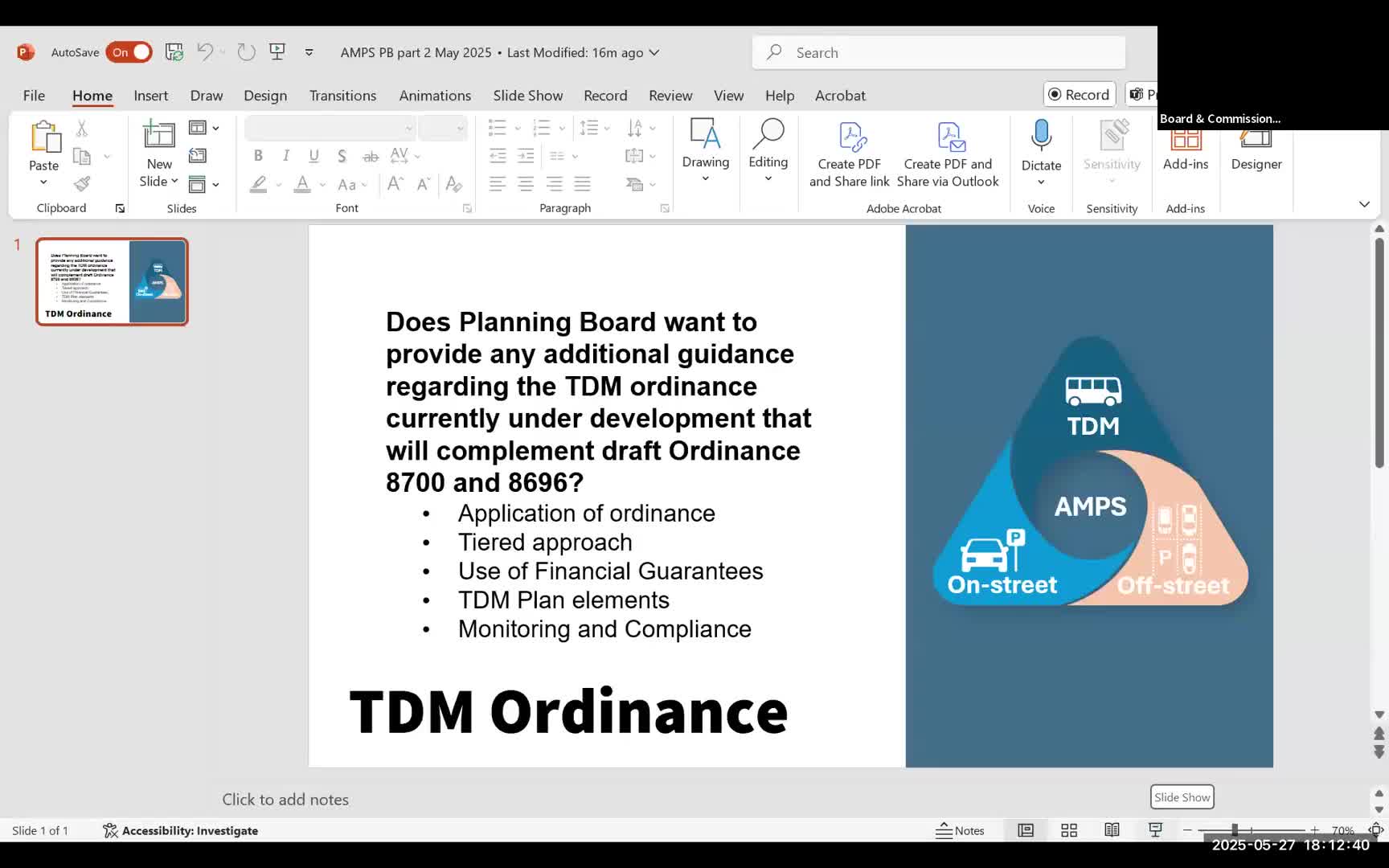
Summary
At a May 27 Planning Board session, staff sought feedback on a draft Transportation Demand Management (TDM) ordinance. Board members urged clearer rules on the duration of financial guarantees, options for cash-in-lieu programs, and protections for affordable housing, and asked staff to return with a draft ordinance in August.
City of Boulder planning staff asked the Planning Board on May 27 for feedback on a Transportation Demand Management ordinance meant to complement recent parking-minimum eliminations and a residential access management program. Chris Haglund, principal project manager, laid out a tiered approach that would apply the ordinance to developments large and small and rely on financial guarantees provided by developers or property owners to fund tenant-level TDM programs.
Board members focused on three practical questions: whether the financial guarantees should be perpetual or reviewed periodically; whether the city should allow a cash-in-lieu option that would let payments be spent citywide; and how the ordinance should treat affordable housing projects. Planning Board member Kurt Nordback said he had “some concerns about a permanent, requirement,” arguing a mechanism to review or revisit long-term guarantees would be appropriate. He also urged making parking pricing a code requirement to change travel behavior.
Claudia (Planning Board member) told staff she supports longer-term commitments for TDM because tenants and uses change over time and exogenous events can disrupt travel patterns, but she also favored a periodic review or sunset so the program could be adjusted as conditions change. She asked that the ordinance include both programmatic and physical infrastructure elements — “best in class bike facilities, transit shelters and furniture, shared ride waiting areas,” she said — so alternatives to driving feel practical and safe.
Several members raised equity concerns. Claudia and others said exempting affordable housing from TDM requirements would reduce access to benefits for residents who may rely on alternatives; staff noted that the city currently subsidizes neighborhood EcoPasses for some Boulder Housing Partners projects and that market-rate projects receive a similar subsidy only after an initial developer period.
On enforcement and monitoring, staff described a compliance approach that could reduce annual monitoring after three years of compliance for large developments and build periodic checks — suggested at five years — into ongoing monitoring. Haglund said staff will examine options including a cash-in-lieu program and alternative methods to calculate annual financial guarantee levels (per unit, per bedroom, or square footage) and expects to return to the board with a draft ordinance in August.
The board did not vote on the proposal; members treated the meeting as a feedback session. Staff recorded the requests and will refine tiers, monitoring, affordability treatment, and financial-guarantee approaches in the next draft.
Ending: Staff will return in August with a draft ordinance that incorporates the board’s feedback on guarantee length, monitoring, tier thresholds, possible cash‑in‑lieu options, and how to measure payments (per unit/bedroom/square foot).