Get Full Government Meeting Transcripts, Videos, & Alerts Forever!
Get email alerts on the Waste Management topic
No spam. Unsubscribe anytime.
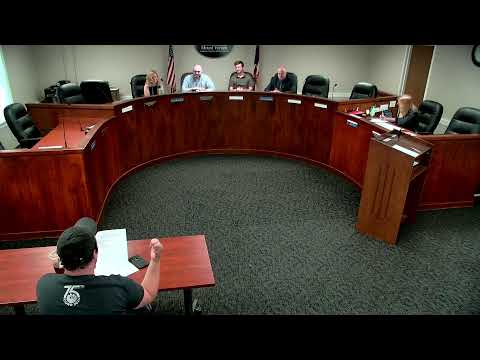
Utilities Commission backs ordinance to license waste haulers, require curbside recycling and annual reports
Summary
The commission on June 5 voted to recommend a draft ordinance to city council that would require waste-hauler licensing, a separate recycling permit with mandatory curbside service, vehicle identification, annual reporting by Oct. 1, and penalties for noncompliance.
The Utilities Commission of the City of Mount Vernon voted June 5 to recommend that city council consider an ordinance to regulate waste haulers, require recycling permits and curbside service, mandate annual reporting, and set enforcement and appeal procedures.
The draft ordinance, presented by the safety service director, would require a waste hauler license and a separate recycling permit from the Office of Code Enforcement; both permits carry a nonrefundable $100 annual fee. "No person or entity shall collect, transport, or dispose of solid waste or recyclable material for commercial purposes within the city without first obtaining a waste hauler license from the office of code enforcement," the presenter said, adding that the administration is moving the permitting responsibility from the police department to code enforcement.
The nut graf: the proposal seeks to ensure curbside recycling is provided citywide, to require visible vehicle identification and secure hauling, and to create a consistent inspection and reporting framework. The commission's recommendation moves the draft to city council for the first reading, expected to appear on the June 9 council agenda.
Key provisions summarized by the presenter include definitions that reference the Ohio Administrative Code for "solid waste," a requirement that vehicles "prominently display the company's name, logo, business address, and telephone number" in lettering no smaller than 3 inches, and a requirement that recycling bins be provided to residents at no additional cost. The presenter said a company operating in Mount Vernon would generally pay $100 for the waste hauler license and $100 for the recycling permit — "So if you are Ted's trash, in order to operate annually in the city of Mount Vernon, it costs $200." The ordinance text states that haulers cannot operate in the city without offering curbside recycling service.
The draft also requires annual reports from licensed haulers and recycling permit holders by Oct. 1 each year. Required report contents listed in the draft include total volume and weight of solid waste collected and disposed, total volume and weight of recyclable materials collected, names and addresses of approved disposal and recycling facilities (separate for each stream), a fleet summary (number of trucks and descriptions), locations where vehicles are stored, and documentation of any spills, littering, or noncompliance and corrective actions taken.
Enforcement measures in the draft include progressive penalties: a written warning for a first violation, a fine not to exceed $500 for a second violation, and suspension or revocation of license and/or permit plus an additional fine up to $1,000 for a third violation. The draft separately makes hauler-caused littering an offense under the city's general litter-control ordinances and states that haulers shall be financially responsible for cleanup and restoration costs if spills or property damage occur.
Commission discussion covered several implementation issues: whether a hauler may subcontract recycling collection (the presenter said companies could document third-party arrangements but that recycling permits and reporting would still be required), how stickering and fleet identification would work for large companies (the presenter said stickers or identifying methods could be handled on a case-by-case basis and replacement stickers may incur a $50 fee), and how the Office of Code Enforcement plans to use permitting software to automate renewals and send 90/60/30-day reminders.
The commission voted to recommend the draft to city council. Roll-call recorded votes in favor were: Siers (yes), Platt (yes), Reinhart (yes) and Bisenberg (yes); Ball was recorded absent and represented by Platt as proxy earlier in the meeting. "Motion carries," the clerk said; the presenter said the ordinance would likely receive a first reading on June 9 and move through council committee and two subsequent readings in June and July unless council alters the schedule.
Discussion versus decision: the commission's vote was to recommend and forward the draft to city council for formal consideration; it did not adopt the ordinance itself. Implementation details (for example, whether third-party subcontractors require both permits or just one) will be clarified administratively and in council consideration.
Ending: The commission's recommendation sends the ordinance to city council for its readings; staff said they will notify haulers when the ordinance appears on council's agenda and will continue refining administrative processes for permitting, sticker issuance and reporting.