Get Full Government Meeting Transcripts, Videos, & Alerts Forever!
Get email alerts on the Education Finance topic
No spam. Unsubscribe anytime.
Auditor General describes process for handling noncompliant school districts; Isaac Elementary remains in receivership
Summary
Auditor General staff outlined the office’s process for identifying and managing school district noncompliance with the Uniform System of Financial Records; Isaac Elementary School District is in receivership and remains noncompliant after status reviews and letters to the State Board of Education.
The Auditor General’s office told the Joint Legislative Audit Committee how it identifies and addresses school district noncompliance with the Uniform System of Financial Records (USFR) and audit‑reporting requirements, and provided an update on Isaac Elementary School District’s status under receivership.
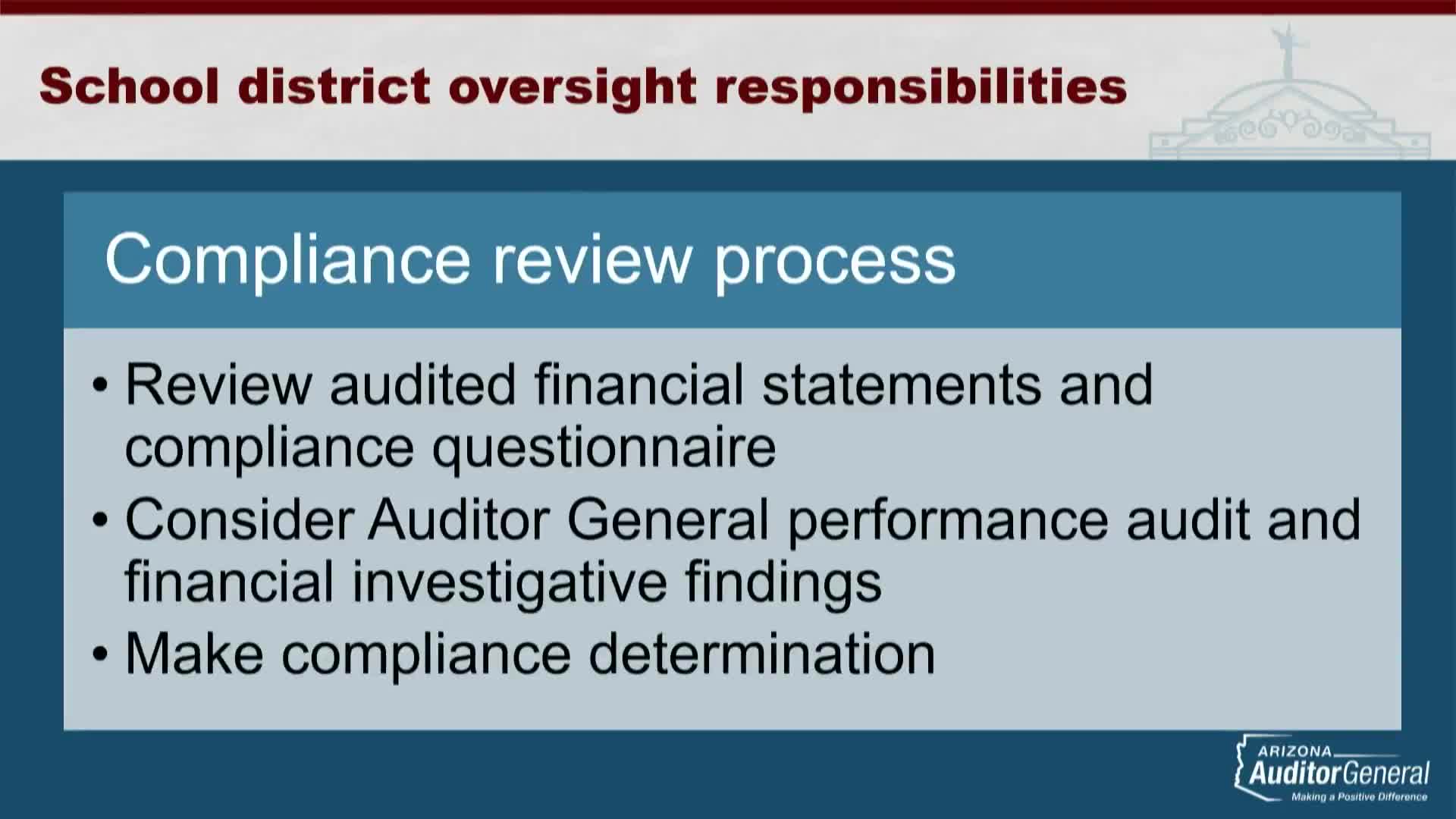
Megan Heager, director of the Auditor General’s accountability services division, described the office’s two‑step process: (1) identify noncompliance when audit reports are late or auditors cite a significant number of deficiencies, send a 90‑day notice and request a corrective action plan (CAP); (2) if the CAP does not demonstrate sufficient progress, auditors conduct a status review and may refer the district to the State Board of Education (SBE) for statutory remedies, including withholding up to 10% of state aid. Heager said the office received new audit reports and is actively completing status reviews for multiple districts.
Heager reviewed the Isaac Elementary timeline: auditors notified Isaac in April 2024 that the district was not in compliance for fiscal year 2023 audit requirements; Isaac submitted reports in June 2024 that showed significant deficiencies; the district entered the Auditor General’s 90‑day correction period beginning July 31, 2024, but auditors concluded Isaac had “not made enough progress” and notified the State Board of Education the district was noncompliant on Dec. 30, 2024. A more recent noncompliance letter, dated April 16, 2025, notifies Isaac that it also is noncompliant for fiscal year 2024 audit requirements.
Keith Kenny, the court‑appointed receiver for Isaac (appointed Jan. 14, 2025), told the committee he has focused first on stabilizing district finances and has taken steps to cut operating costs, renegotiate or cancel contracts, and reduce staff to reduce a negative cash balance. Kenny said he will prioritize corrective actions tied to the most recent audits once the fiscal‑year‑2024 audit report is finalized and available: “My intention…will be, once that fiscal year 24 report comes out, we will immediately start developing a corrective action plan based on those findings,” he said. Kenny also described the district’s immediate priority to ensure payroll and operations could continue when receivership began.
Heager said 11 districts have been referred to the State Board for noncompliance after the 90‑day process or a status review; additional districts are in status review or have pending letters for fiscal year 2024 audits. She noted there are 236 school districts in Arizona and—at the time of her presentation—39 districts were in some form of noncompliance (late audits or internal control deficiencies).
Heager described how the Auditor General’s office works with district officials during the 90‑day CAP period, reviews corrective action plans, conducts on‑site status reviews where appropriate, and reports to the State Board of Education if the CAP does not show sufficient progress. She also said the office coordinates with the State Board, Department of Education and county offices for districts under financial stress.
Kenny told the committee he considers the Isaac situation “gross mismanagement” based on his initial reviews, and that the district had a negative cash balance of just over $20 million when receivership began. He said the receiver has frozen nonessential purchases and pursued property sales and other steps to stabilize operations and prepare a FY 2026 budget.