Get Full Government Meeting Transcripts, Videos, & Alerts Forever!
Get email alerts on the Industrial Siting Wildlife topic
No spam. Unsubscribe anytime.
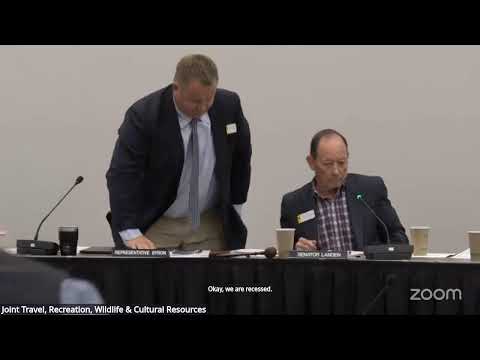
Lawmakers discuss compensatory mitigation for industrial siting after game & fish urges off‑site options
Summary
Senators and representatives at the June 5 Travel, Recreation, Wildlife & Cultural Resources interim meeting discussed whether industrial siting should include a statutory mechanism to fund compensatory mitigation when impacts to wildlife cannot be avoided on‑site.
Senators and representatives at the June 5 Travel, Recreation, Wildlife & Cultural Resources interim meeting discussed whether industrial siting should include a statutory mechanism to fund compensatory mitigation when impacts to wildlife cannot be avoided on‑site. "If you can't mitigate this on‑site, then we go off‑site and mitigate this," Senator Brian Hicks said, describing a proposal to allow the Wyoming Game and Fish Department to request compensatory mitigation funding through the industrial siting council for large projects.
The nut graf: The industrial siting council permit process is adjudicative and fact‑driven; DEQ Industrial Siting Administrator Jenny Stabin summarized the five steps (pre‑application engagement, application submittal, comment and condition requests from state agencies, a contested‑case hearing before the council, and long‑term monitoring/bonding). She noted the council must find that a proposed facility complies with applicable law, does not pose a threat of serious environmental or socioeconomic injury and will not substantially impair health, safety or welfare of inhabitants before granting a permit.
Stabin told the committee the statute obliges applicants to work with 19 state agencies during pre‑application and application phases and that agencies may request specific permit conditions; those recommendations become enforceable only when the council includes them in the permit. Industrial siting permits frequently cover multi‑decade projects; DEQ and the council retain jurisdiction through construction, operation and reclamation, and bond requirements are reviewed periodically. Stabin recited statutory thresholds that trigger industrial siting review (a construction cost threshold, turbine counts, and solar size or acreage) and noted permit violations can carry fines (noted in testimony as up to $10,000 per day).
Game and Fish Director Angie Bruce told the committee her agency conducts extensive wildlife reviews — about 500 to 700 environmental reviews a year across programs — and has worked on 27 industrial siting projects in the last decade. Bruce said staff commonly spend roughly 325 hours on each project and that many projects require multi‑year monitoring and adaptive measures. She described typical work with proponents: site avoidance and micro‑siting (shifting turbines/roads within a larger footprint), monitoring for wildlife impacts, and proposals for mitigation when avoidance is not possible. "We're not here to stop development," Bruce said. "We're here to work with proponents to reduce impacts and prioritize important habitat."
Senators and staff discussed where projects occur — much industrial renewable development in Wyoming has been proposed on private land because of NEPA timelines on federal lands — and how federal planning, the U.S. Fish and Wildlife Service and the Bureau of Land Management influence mitigation obligations (for example, nest buffers and other federal requirements can affect where infrastructure is allowed). Several conservation groups and researchers who testified afterward urged targeted mitigation funding that emphasizes priority habitats and scientific monitoring; industry voices stressed the need for predictability and warned that additional fees or uncertainty could make Wyoming less competitive for projects that require hundreds of millions in capital.
Committee action: The TRW committee voted to carry the industrial‑siting/wildlife‑mitigation discussion forward to its next meeting and invited the Minerals Committee and other stakeholders to coordinate; no statutory change was adopted at this meeting. Members instructed staff to prepare materials and possible draft options for the next interim meeting and discussed whether the state should consider a compensatory mitigation fund, fee recoupment for agency workload, or clearer statutory authority for off‑site mitigation when projects cause unmitigable impacts.
Ending: Committee members agreed the topic is complex and multi‑jurisdictional, and requested additional cross‑committee briefing and draft language for future consideration rather than immediate statutory action.