Get Full Government Meeting Transcripts, Videos, & Alerts Forever!
Get email alerts on the Nonmotorized Trails Funding topic
No spam. Unsubscribe anytime.
Panel weighs nonmotorized trail fee to close funding gap as visitation rises
Summary
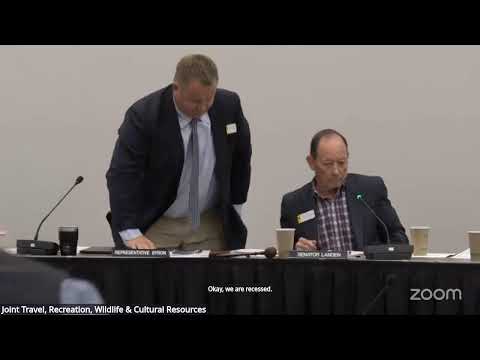
Deputy Director Chris Floyd and Trails Program Manager Forrest Kuminga told the Travel, Recreation, Wildlife & Cultural Resources interim committee on June 5 that demand for nonmotorized trail funding in Wyoming far exceeds available sources and that the state should consider a user‑fee model similar to its motorized decal program.
Deputy Director Chris Floyd and Trails Program Manager Forrest Kuminga told the Travel, Recreation, Wildlife & Cultural Resources interim committee on June 5 that demand for nonmotorized trail funding in Wyoming far exceeds available sources and that the state should consider a user‑fee model similar to its motorized decal program. "We have more requests for nonmotorized trails than any other type of request," Floyd said, and noted the federal Recreational Trails Program (RTP) provides only a little more than $400,000 a year statewide for nonmotorized projects.
The nut graf: The agency presented a menu of options — a mandatory or voluntary pass for mechanical nonmotorized users (for example, class 1 e‑bikes treated as nonmotorized, class 2/3 as motorized), resident/nonresident pricing, enrollment of federal and private trails into a state program, and use of the proposed Outdoor Recreation Tourism Trust Fund — to raise funds for construction, maintenance, enforcement and visitor infrastructure. Deputies noted the motorized decal program sells tens of thousands of permits and generates revenue that supports construction, enforcement and access protection on enrolled trails.
Floyd and Kuminga said the state receives roughly $47,000,000 in nonmotorized requests that bubbled up over several years; ARPA provided about $24,000,000 as a 1‑off that helped fill needs but is exhausted. The RTP allocation for Wyoming’s nonmotorized projects is approximately $400,000 a year, which committee members and presenters described as insufficient for statewide needs. Floyd illustrated a baseline fee model: a modest per‑machine or per‑user annual sticker (for example $10–$15 resident; higher nonresident rates) could double or triple nonmotorized trail funding if similar participation rates to motorized programs were achieved. He estimated a modest program could generate $500,000–$750,000 annually under conservative take rates.
The deputies stressed enrollment and partnership are important steps: an enrolled trail becomes eligible for state grant funds and enforcement resources. Forrest Kuminga said many federal land managers welcome grant funding for nonmotorized needs because federal agencies face staffing and budget constraints. The agency suggested the state begin by applying new funding to trail construction, maintenance, signage, enforcement and trailhead sanitation, then evaluate match requirements and scoring for trust fund applicants.
Committee members raised practical questions: how to enforce a nonmotorized fee, exemptions for youth and low‑income families, tiered fees by user type (equestrian vs. mountain bike), private‑land easement liability concerns, and permitting technology (stickers, plates, or electronic passes). Deputy Floyd said enforcement mechanisms exist in the motorized model — a mix of on‑the‑ground enforcement and above‑90% compliance rates — and a similar approach could be adapted for nonmotorized users. Several legislators urged caution about new mandatory fees during an upcoming budget session but supported exploring feasible alternatives, including statutory changes to allow use of local lodging tax revenue for trail infrastructure or drafting legislation to establish a state nonmotorized program modeled on motorized decals.
Public commenters from conservation nonprofits, universities and the outdoor industry urged the committee to align any fee with conservation goals, to prioritize habitat and wildlife concerns in trail siting, and to look at other states’ approaches (Idaho, Indiana, Wisconsin, Colorado) when designing a Wyoming program. University of Wyoming researchers offered to study fee models and revenue projections.
Ending: The committee asked staff to draft potential legislative language and to examine options further at the next interim meeting; lawmakers debated whether to pursue a standalone fee, a lottery/lodging trust fund diversion, or a more limited change that uses existing fee authority on state lands first.