
Orting reports sizable preliminary SBA gains; district adds UFLI reading program midyear
Get AI-powered insights, summaries, and transcripts
Subscribe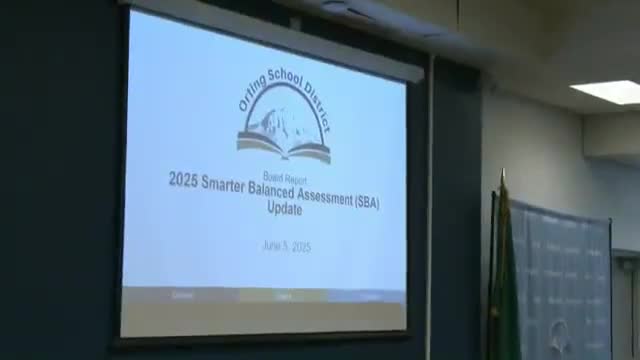
Summary
District leaders presented preliminary Smarter Balanced assessment results showing notable year-over-year gains and described a midyear rollout of the University of Florida Literacy Institute (UFLI) for early grades and related curriculum and scheduling changes.
Orting School District officials told the board Wednesday that preliminary Smarter Balanced Assessment (SBA) results show meaningful year-over-year gains in reading and math, and described steps the district is taking to sustain that progress, including adoption of an explicit early-literacy program.
Director Steve Brown (title in meeting: presenting director) said preliminary ELA grade-level average growth moved from about 1.6% last year to roughly 7% this year; he also reported math growth reversing a prior negative average and improving districtwide. Brown framed the gains as part of a multi-year effort involving curriculum adoption, new interim assessments and teacher collaboration.
"When we look at our ELA grade level data ... the average growth last year of our grade levels was 1.6%. This year ... it's 7%. That's impressive," Brown said. He also noted individual grade improvements cited in district materials: fourth grade about 9.5%, fifth grade about 10%, and sixth grade about 13% (figures preliminary and labeled by staff as not-final).
District literacy staff told the board the district deployed the University of Florida Literacy Institute (UFLI) program midyear for kindergarten through second grade to strengthen explicit instruction in foundational reading skills. Dr. Westover said teachers and principals determined that some early-reading components in the previously adopted materials were not explicit enough to teach phonics and foundational skills at the needed level, so the district implemented UFLI midyear and will continue it into next year for K—2 and selectively for third grade as needed.
"We brought [UFLI] in mid year...the kids love it. They can't wait until we do UFLI. And kids are engaged and then instruction is very explicit," Dr. Westover said.
Superintendent and academic leaders also described other changes that feed the district's improvement efforts: focused interim assessment blocks aligned to standards, teacher professional learning communities (PLCs), modified master schedules at elementary schools to make room for UFLI, and coaching for teachers on core instruction and interventions.
District leaders cautioned the results were preliminary: staff repeatedly said results were subject to final validation and state comparisons were not yet available. They framed the data as evidence the instructional "flywheel" the district has worked to build is beginning to turn and asked for continued board support as the work moves from pilots and interim measures to systemwide implementation.
Why it matters: The combination of stronger interim assessment systems, an explicit early-literacy program and teacher-focused inquiry work represents an operational shift designed to accelerate students to grade-level reading. District leaders tied the changes directly to the district goal of increasing mastery of core ELA and math competencies.
What to watch: Implementation fidelity for UFLI in kindergarten through second grade, the planned January mid-year review of third-grade progress, and final, state-validated SBA outcomes expected after data validation.