Get Full Government Meeting Transcripts, Videos, & Alerts Forever!
Get email alerts on the Evidence Admissibility topic
No spam. Unsubscribe anytime.
Appeals court weighs admissibility of prior California-assault evidence in Commonwealth v. Sonke
Summary
An appeals court panel on Friday, June 6, heard arguments over whether testimony about alleged assaults that took place in California should have been admitted at the trial in Commonwealth v. Sonke, a single-issue appeal that centers on the limits of prior-bad-act evidence.
An appeals court panel on Friday, June 6, heard arguments over whether testimony about alleged assaults that took place in California should have been admitted at the trial in Commonwealth v. Sonke, a single-issue appeal that centers on the limits of prior-bad-act evidence.
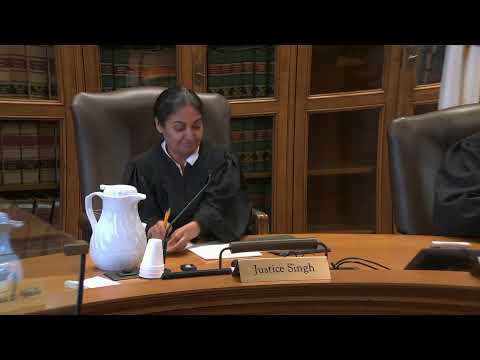
The question matters because appellate guidance could change how trial courts balance probative value against unfair prejudice when prosecutors introduce uncharged-conduct testimony. Justice Sabida Singh, joined by Justice D'Angelo and Justice Hodgins, presided over the oral argument; the court submitted the case after hearing from defense counsel William Corman and the attorney for the Commonwealth, Kristen Jang.
Defense counsel William Corman argued the California incidents overwhelmed the jury and were unduly prejudicial. Corman told the panel that, although prior-bad-act evidence can be admissible for limited purposes, in this case "at some point, it crosses the line," and he urged the court to adopt clearer boundaries for when such evidence should be excluded. Corman noted that roughly 20% of the Commonwealth's opening statement and about 20% of the victim's direct testimony concerned the California incidents and said a juror's midtrial note asking for clarification about the "status of any charges in California" showed jurors were considering the foreign incidents for an improper purpose rather than only under the judge's limiting instruction. Corman also raised late disclosure and a subsequent voir dire of the complaining witness as complicating factors and said the defense had been placed in a tactical bind by the introduced testimony.
Kristen Jang, arguing for the Commonwealth, said the trial judge "did not abuse her discretion" in finding that the probative value of the California-assault evidence outweighed the risk of unfair prejudice. Jang told the court the details of the earliest alleged incident, when the victim was about 10 years old while the family lived in California and later 12 in Massachusetts, were particularly probative of the nature of the relationship and the reasons for delayed disclosure. Jang acknowledged the balancing is fact-specific and that the line between probative context and improper propensity evidence is difficult to draw, but she said the evidence was relevant to the victim's delayed reporting and to corroborating aspects of the victim's account, including an identifying physical modification the victim described.
The justices questioned both sides about practical ways to cabin detail — for example, whether defense counsel had asked in limine to admit only limited aspects of the testimony rather than seek wholesale exclusion, and whether judges or prosecutors should be more specific in explaining the limited purposes for which the jury may consider prior acts. The attorneys and justices discussed the judge's limiting instruction, which included standard Rule 404(b)-type purposes (motive, intent, identity, pattern, method, nature of the relationship) and whether that litany can be so broad that jurors treat the evidence as permissible for multiple purposes. Jang noted the prosecutor's closing argument expressly told jurors the California evidence was offered to give context about the relationship and the victim's life, which she said mitigated concerns about misuse.
Both sides referenced appellate decisions cited in briefs; defense counsel pointed to a dissent in the Childs-related authority (arguing for firmer limits), and the Commonwealth cited cases the judge relied on at trial. Neither side asked the panel to enter a specific remedy at argument; the justices ultimately announced the case as submitted for decision.
The appeals court's forthcoming decision will determine whether the trial court's balancing of probative value against unfair prejudice in this record was appropriate and may provide further guidance on when detailed testimony about uncharged incidents is permissible in child-assault prosecutions.
The case was submitted to the panel for decision.