Get Full Government Meeting Transcripts, Videos, & Alerts Forever!
Get email alerts on the White Stadium Environment topic
No spam. Unsubscribe anytime.
City officials outline environmental commitments for White Stadium redevelopment
Summary
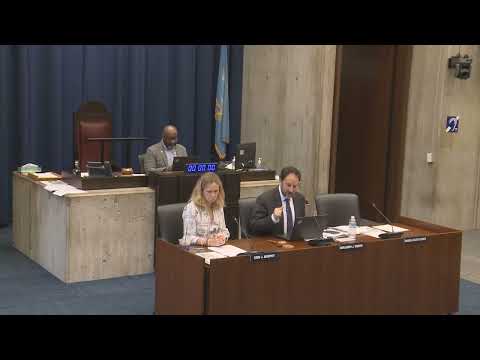
Boston City Councilors and city environmental officials on June 6 heard a presentation on the environmental elements of the White Stadium redevelopment in Franklin Park, including stormwater controls, expanded public access, tree protections and a $3 million tree bank to fund 500 new trees.
Boston City Councilors and city environmental officials on June 6 heard a presentation on the environmental elements of the White Stadium redevelopment in Franklin Park, including stormwater controls, expanded public access, tree protections and a $3 million tree bank to fund 500 new trees.
The presentation from city staff framed the project as aligned with the Franklin Park Action Plan and argued the design reduces paving, preserves existing trees where possible, and includes infrastructure to mitigate flooding on the Playstead. "We are here to walk, through the environmental commitments and park improvements tied to the White Stadium Project," said Brian Sweatt, chief climate officer for the Environment, Energy, and Open Space Cabinet.
The plan presented by city staff said the project will: intercept and store stormwater on-site using underground chambers intended to reduce flooding on adjacent park lawn areas; preserve more than 100 trees and plant roughly 500 new trees over the next 10 years, including 60 to 70 large canopy trees inside the stadium perimeter; provide two park-facing restrooms whose maintenance is covered by the stadium lease; expand public access hours from 40 to 105 hours per week; and eliminate on-site spectator parking in favor of shuttles, bicycle access and transit. "There are more than a hundred preserved trees, and improved soil systems for the existing trees root zones," said Sam Valentine, senior landscape architect with the Boston Planning Department and a certified arborist.
City staff also described regulatory review steps they completed under Boston's Article 80 large project review. Sam Valentine said the project addressed the Article 80 checklist including shadow, air and water quality, flood hazard, wildlife habitat, noise and construction impacts. Staff said portions of the work are planned to be LEED-certifiable (the west side aiming for platinum, guaranteed at gold; the east side to be at least silver) and that proponents aim for net-zero carbon operation for the completed stadium.
Officials described tree protections already installed on site and explained the tree mitigation accounting method. Valentine said the city used a caliper-inch replacement approach rather than a one-for-one count, which led to the 500-tree mitigation figure and a $3 million tree bank that includes a two-year warranty for newly planted trees. "We calculated the total removals by caliper inch, and that landed us on what eventually became the $3,000,000 number for 500 new trees," Valentine said. He also said that of the trees identified for removal in the public tree meeting, "80% of the trees, 79 to be specific, fall under the category of poor, dead, dying, or diseased." Councilors asked for follow-up exhibits showing the change in the stadium footprint; staff said the new east facade will be roughly 40 feet east of the previous facade and that the project yields about an acre of currently fenced-off open space back to the park.
Officials said the stadium will be an all-electric facility and that the team and operators committed to cover maintenance of the park-facing restrooms. Staff reiterated there will be no on-site parking for spectators and that transportation planning anticipates electric shuttles and coordinated use of transit, but they acknowledged the shuttle routing and staging were not yet finalized. "To my knowledge, that decision has not been finalized," staff told Councilor Lydia Edwards when asked about shuttle origins.
Councilors and staff described next steps: finalize construction documents, transition from demolition to construction, and establish a White Stadium Neighborhood Council to coordinate operations, transportation and programming. City staff said they will continue digesting public comments on the posted transportation plan and will stand up the neighborhood council before the stadium opens, with further community engagement through construction and operations.
Supporters and advocates at the hearing noted the project's investments in park maintenance and infrastructure. Councilor Aaron Murphy thanked staff for the presentation and emphasized that transportation remains a central outstanding issue for residents. "We did hear at one of our hearings that Fields Corner was not going to be used," Councilor Murphy said, summarizing concerns about shuttle origins and neighborhood impacts.
Where details were not finalized, staff promised follow-up materials and exhibits. Council members pressed for additional information on the timeline for electric shuttles, the precise construction management plan, and confirmation that the tree bank funds will be used within Franklin Park under parks department direction.
A hearing handout and slide materials were referenced during the presentation and committee members requested that staff provide exhibits showing the old and new footprints and a clearer transportation response to public comments.
The committee did not take a formal vote during the hearing; staff closed by saying they would continue outreach and return with updated exhibits and plans.