
Senate adopts amended budget bills after hours of debate over Medicaid, housing and vouchers
Get AI-powered insights, summaries, and transcripts
Sign Up Free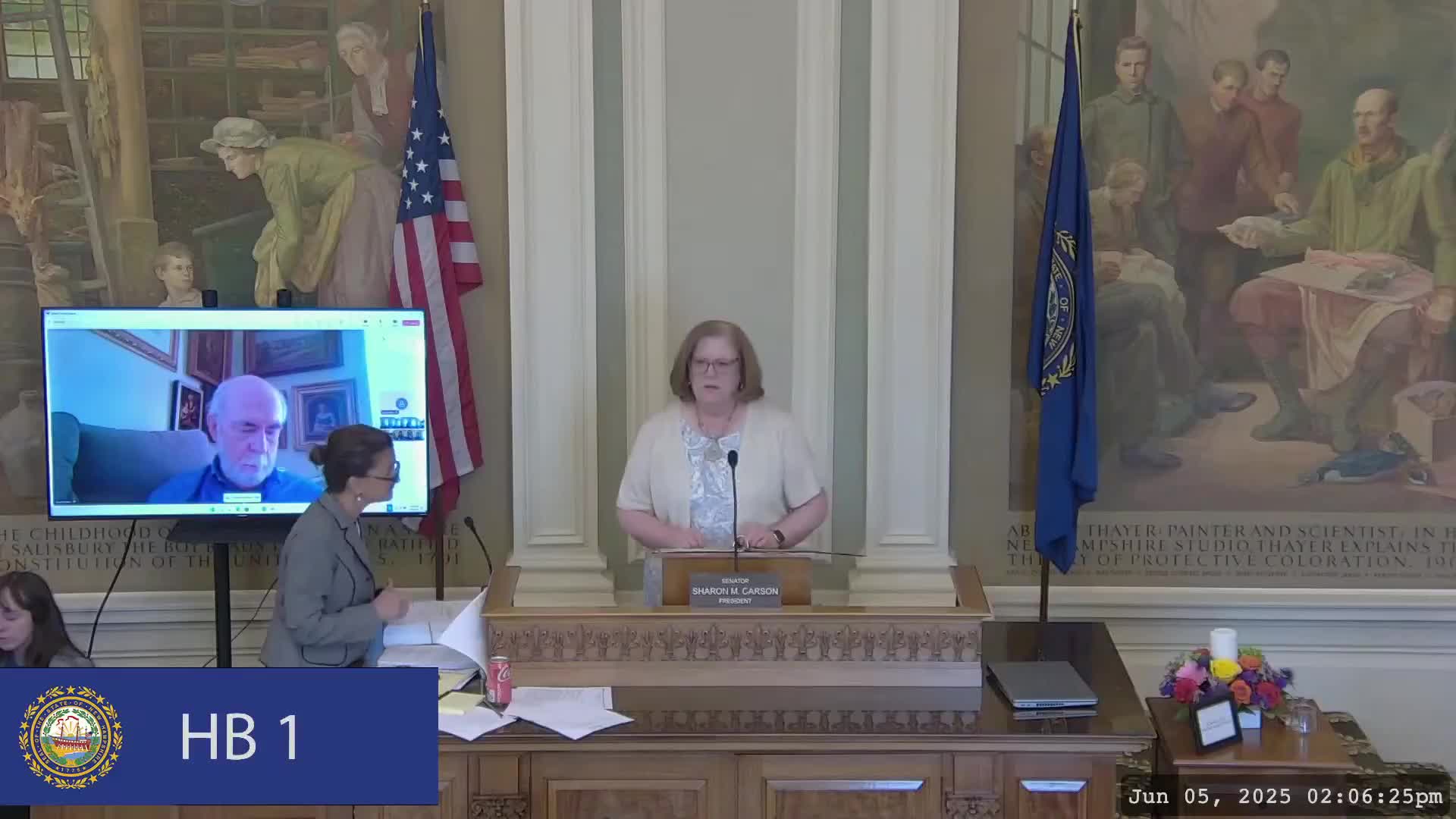
Summary
The New Hampshire Senate approved House Bill 1A and House Bill 2 after extended debate and multiple floor amendments, restoring some cuts to Medicaid, developmental services and community mental health while rejecting several proposed additions; the full biennial operating and capital measures now proceed to third reading.
Concord — The New Hampshire Senate on a series of late‑day votes approved amended versions of the two main budget measures, House Bill 1A and House Bill 2, after extended debate that centered on Medicaid funding, housing, education aid and school voucher expansions.
The Senate Finance Committee recommended adoption of House Bill 1A “ought to pass” with amendments, and Senator Gray, the committee sponsor, said the panel had restored “the 3% house cut to Medicaid, funding developmental services to ensure … there’s no wait list, and funding the community mental health.” He asked colleagues to support the committee’s work in amending the House budget.
The bill passed the Senate on a roll call, with the clerk recording: “The ayes have it by a vote of 15 to 9. House bill 1A is adopted and ordered to third reading.”
Why it matters: The two bills together set the state’s spending priorities for the coming biennium and contain a number of policy choices that senators framed as either protections for vulnerable residents or tradeoffs to control overall spending.
Key decisions and votes
- House Bill 1A: Committee amendment adopted; final passage to third reading recorded as 15–9 in favor. Senator Gray framed restored items as responding to public testimony on Medicaid rates, developmental disabilities and community mental health. Senator Rosenwald and others warned that the overall package still included cuts to affordable housing, higher education and other services.
- House Bill 2 (general appropriations and policy): After lengthy committee work and many floor amendments, the Senate ordered House Bill 2 to third reading. The clerk recorded the final procedural vote (motion to order to third reading) as 14–10 in favor.
Major program changes and dollar items cited on the floor
- Medicaid: The finance committee restored rate changes the House had cut; Medicaid provider reimbursement and related policy were prominent in committee and floor debate.
- Developmental services and community mental health: Committee language aimed to prevent wait lists and restore funding the House had reduced.
- Education: The package was described on the floor as sending “more than a billion dollars in education adequacy payments” to local school districts in the next year; the committee and floor also debated targeted assistance and formula adjustments.
- Higher education: The Senate amendment increases state funding for the university system by roughly $85,000,000 a year according to Senator Gray’s floor remarks.
- Water/wastewater and local infrastructure: The committee recommended $71,500,000 for local water and wastewater projects and preserved room‑and‑meal revenue sharing at 30% for municipalities.
- Childcare and workforce: The package included $15,000,000 for childcare workforce programs; senators proposed additional childcare funding in floor amendments that were debated and defeated.
- Youth facility settlement fund (Sununu Youth Services Center/YDC): The Senate committed $100,000,000 to a settlement fund tied to the sale of the Manchester facility, and some senators pressed for larger appropriations; a floor amendment to add an additional $50,000,000 was proposed and defeated after a roll call.
What senators warned about
- Several senators, including Rosenwald and others, argued the package still represented net reductions in some high‑priority areas such as affordable housing and some human services programs, and urged caution about nonrecurring revenue assumptions (sale of property) used to fund the settlement account.
- Multiple floor amendments sought to reallocate or add funds for housing, childcare, higher education and renewable energy; several were debated and defeated on roll calls. Senator Perkins Quoca and others argued for greater housing investment and asked colleagues to prioritize housing over expansions of the voucher program.
Where things go next
The bills were ordered to third reading for final passage. Senate votes on amendments and the recorded roll calls will be part of the official journal and determine final numbers that will go to the House for concurrence or conference committee negotiations.
Ending
Senators used the floor process to press competing priorities—restoring provider funding and mental‑health resources while resisting several proposed additions. The budget’s broad contours are now set in the Senate; further adjustments are possible during third reading or any ensuing conference with the House.