Get Full Government Meeting Transcripts, Videos, & Alerts Forever!
Seattle officials brief council on '1 Seattle Plan' major comprehensive-plan update and growth strategy
Summary
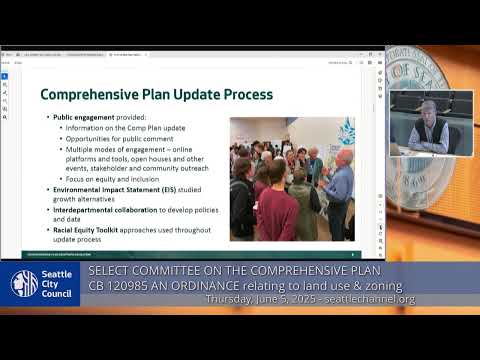
City planning staff and the mayor’s office briefed the Seattle City Council select committee on the final "1 Seattle Plan," a major 20‑year update to the city’s comprehensive plan that revises goals, adds a climate element, and reorganizes a growth strategy around regional, urban and new neighborhood centers.
City planning staff and the mayor's office presented the final draft of the "1 Seattle Plan," a major update to Seattle's comprehensive plan, at the June 5 meeting of the City Council's select committee on the comprehensive plan. Michael Hubner, project lead at the Office of Planning and Community Development (OPCD), told the committee the plan is “a 20 year plan for growth,” framed to respond to state and regional requirements and the city’s housing crisis.
The plan update revises the citywide policy elements and technical appendices, adds a new climate mitigation and resilience element, and includes a generalized future land use map that organizes places into a hierarchy of centers and an "urban neighborhood" place type. Hubner said the update is designed to “improve the supply, diversity and affordability of housing types in neighborhoods across the city” and that it will be submitted to the Puget Sound Regional Council (PSRC) for consistency review following adoption.
Why it matters: the comprehensive plan sets the policy framework for land use, capital investments and transportation priorities across the city for the next two decades. Adoption is the prerequisite before the city can enact implementing zoning legislation the presenters said; zoning that will implement changes to neighborhood residential areas and centers will be transmitted later in the process.
Key elements and mapping changes described by presenters
- Centers and place types: the draft plan retains and modifies a centers-based growth strategy. Hubner said regional centers (the largest, densest areas)…
Already have an account? Log in
Subscribe to keep reading
Unlock the rest of this article — and every article on Citizen Portal.
- Unlimited articles
- AI-powered breakdowns of topics, speakers, decisions, and budgets
- Instant alerts when your location has a new meeting
- Follow topics and more locations
- 1,000 AI Insights / month, plus AI Chat