Get email alerts on the Manufacturing Competitiveness topic
No spam. Unsubscribe anytime.
Witnesses tell Joint Economic Committee that cutting regulatory burden, updating R&D tax rules and using AI could boost U.S. manufacturing
Summary
At a Joint Economic Committee hearing, a committee member and two witnesses discussed how regulatory burden, research-and-development tax treatment and artificial intelligence could affect domestic manufacturing competitiveness and supply chains.
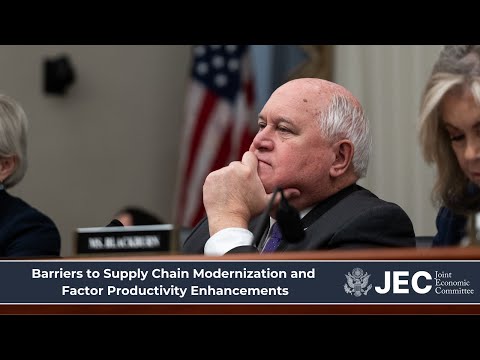
A committee member at a Joint Economic Committee hearing pressed witnesses Tuesday on whether reducing regulatory burdens, changing tax treatment for research and development and adopting new technologies such as artificial intelligence could help spur more domestic manufacturing and reduce reliance on foreign producers.
The committee member said U.S. production has moved overseas and said, “we can't allow things like semiconductors to be, an area where we're dependent on somebody else.” The lawmaker asked witnesses about how regulatory accumulation and tax policy affect private investment in research and development and about the potential for AI to increase factory productivity.
Dr. McLaughlin, a witness who presented a study on regulation and growth, told the committee his research estimated a roughly 0.8% reduction in gross domestic product attributable to regulatory burden. He cautioned his study did not directly examine interactions between regulation and tax policy: “my study didn't directly, examine the interaction between regulations and tax policy,” he said. He also told the committee that other work corroborates a growth effect, and he cited British Columbia as an example: he said that province cut regulations by about 40% between 2001 and 2004 and that “GDP growth went up by 1.2%.”
The committee member referenced estimates from the Joint Committee on Taxation and the Congressional Budget Office and said that a 0.8% increase in GDP growth could raise about $3 trillion in federal revenue over 10 years, framing the growth argument as relevant to budget and deficit discussions.
Dr. Shevy, another witness, described how advanced analytics and machine learning could improve manufacturing decisions by enabling firms to analyze larger datasets and coordinate across internal silos. “AI allow you to look at much more data... so your decisions are based on facts,” he said, and added that better forecasts help companies “skate to where the puck is gonna be.” He connected those capabilities to improved forecasting of demand and production planning.
The committee member noted the economic importance of aerospace manufacturing in the Fourth District in Kansas, citing local companies including Spirit, Textron and Bombardier as examples of firms seeking productivity and modernization. The witnesses and the committee member discussed supply-chain modernization and factory productivity improvements as part of the broader competitiveness conversation but did not identify or adopt any formal policy actions during the hearing.
No votes or motions were made on these topics during the recorded exchange. Committee members asked for evidence and discussed policy options; witnesses identified research findings and technological possibilities but did not offer specific legislative text or regulatory proposals in the exchange recorded in the transcript.
The hearing continued to other witnesses after the exchange; no formal direction to staff or committee action on changes to regulation, R&D expensing, or AI deployment was recorded in the provided transcript segment.
AI generated
The text on this page is AI generated. Summaries, highlights, analysis, and video transcripts are all produced from the original source material.
AI can make mistakes, so if you spot one, and we will fix it for everyone.
Note: the source content is unaltered by us. Any content source we link to, be it a video, an audio recording, or a document, is presented exactly as its publisher released it. That publisher is usually a government body, sometimes an individual official or another organisation.