Get Full Government Meeting Transcripts, Videos, & Alerts Forever!
Get email alerts on the Supply Chain Modernization topic
No spam. Unsubscribe anytime.
Joint Economic Committee hearing explores port automation, regulatory pace and workforce tools to modernize U.S. supply chains
Summary
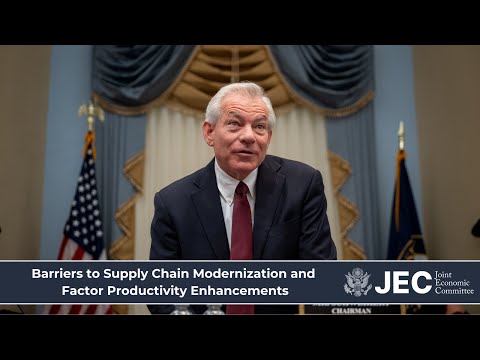
At a hearing of the Joint Economic Committee (date not specified), the committee chair and a panel of experts discussed how automation, regulatory change and workforce tools could reshape U.S. supply chains, with an emphasis on ports, regional manufacturing and the pace of regulation.
At a hearing of the Joint Economic Committee (date not specified), the committee chair and a panel of experts discussed how automation, regulatory change and workforce tools could reshape U.S. supply chains, with an emphasis on ports, regional manufacturing and the pace of regulation.
The committee chair opened the panel by asking experts to imagine a ‘‘clean-slate’’ vision for more efficient supply-chain infrastructure and said Congress and regulators currently slow investment: "The the vision for this hearing was what can we make the future look like?" the chair said. He framed the conversation around automation at ports, electric skids for rail and next-generation container handling that could cut handling times from hours to minutes.
Panelists said the United States has the technology to speed modernization but that investment is held back by legal and regulatory uncertainty, incumbent interests and the slow pace of rulemaking. "We need things that are streamlined, need things that are flexible, things that accommodate new technologies when they do come about," said Dr. McLaughlin, a panelist, arguing that regulatory infrastructure should be designed to permit innovation. "The procedure is defined by Congress, the Administrative Procedure Act," Dr. McLaughlin added, noting that rulemaking timelines and procedures limit how fast agencies can adapt.
Why it matters: Panelists tied automation and regulatory reform to workforce shortages and long-term competitiveness. They warned that investments from acts such as the CHIPS Act could become stranded if technologies outpace the planned infrastructure or cleanup capacity. The panel also flagged demographic shifts and immigration policy as factors that will influence whether automation is adopted broadly and how quickly.
Most important proposals and concerns
- Automation at ports and terminals: The chair and a panelist pointed to existing terminal operators — including global conglomerates and authorities such as the Port of Singapore Authority — as ready adopters of efficiency technologies but said uncertainty and regulation often cancel projects. One panelist said, "There are already corporations, which are many of them are branches of shipping lines that are experts at making supply chain efficient... but when their strategy or their investment hit the road and they encountered the regulatory system, the delay in investment." Panelists cited examples abroad (Dubai, Rotterdam, Chinese highways and European high-speed rail) to show what rapid, centralized investment can produce.
- Regulatory pace and the ‘‘pacing problem": Several witnesses described a gap between fast-moving technology and slower regulatory processes. Dr. McLaughlin called this the pacing problem and said faster updates to regulation, potentially using AI or crowdsourced data, could narrow that gap. "If instead we're able to update regulations more quickly using AI, for example, or crowdsourcing, we wouldn't run into this problem nearly as often," Dr. McLaughlin said.
- Crowdsourcing and monitoring: The chair and a panelist discussed the potential for crowdsourced environmental and operational monitoring (air and water quality, equipment failures) to reduce delays and enforcement gaps. A panelist cited an existing organization by name: "There is a nonprofit called NIICA, which, which actually has the software to do this." Panelists emphasized that legal pathways would be needed for agencies to accept crowdsourced data under current statutes and agency procedures.
- Workforce matching and training: A panelist described off-the-shelf software and ‘‘turn-by-turn’’ guidance to help workers move from current jobs into roles industry needs, giving an anecdote of a former Dunkin' worker who matched to skills needed at a semiconductor fabrication plant and was retrained for that role. The panelist said the tools to map credentials and training paths to employer needs exist, but that coordination among community colleges, universities and employers is required.
- Demographics, immigration and job displacement: The chair and panelists raised demographic trends as a driver of automation: panelists noted an aging population and a smaller cohort of 18-year-olds, and the chair said those shifts increase pressure to raise productivity. They also warned automation will create winners and losers — for example, that truck driving is the top job in many states and that autonomous trucks will face strong political resistance. The chair asked whether immigration reform or technology adoption should be the primary lever to address labor shortages.
- Repatriation and stranded assets: Panelists discussed the limits of industrial policy without matching environmental and waste-management infrastructure. A witness recalled testimony about pharmaceutical precursor production outside the U.S., and cautioned that repatriating certain industries would require new mitigation capacity for hazardous byproducts. The chair further warned that investments under the CHIPS Act could risk becoming stranded if subsequent technological advances change production needs.
What the hearing did not do
No formal actions, votes or directives were taken during the hearing. The panel produced ideas and examples but did not produce any committee votes or binding outcomes. The chair closed the session after the panel exchange and thanked panelists for their testimony.
Context and next steps
Panelists asked Congress and agencies to consider procedural reforms to speed rulemaking and to explore pilots that allow trusted, crowdsourced monitoring and AI-assisted updates to guidance. They also urged coordination among workforce training programs, employers and immigration policy to manage short-term disruption while sustaining long-term productivity gains. The committee did not set a timetable for follow-up or for drafting legislative changes.