Get Full Government Meeting Transcripts, Videos, & Alerts Forever!
Get email alerts on the School Safety topic
No spam. Unsubscribe anytime.
Board introduces revisions to safety policies, including framework to consider school engagement officers; Garfield principal urges piloted, limited role
Summary
The Seattle School Board on June 4 heard proposed revisions to district safety policies that would consolidate firearms and emergency rules and create a framework for campus‑specific agreements allowing narrowly defined school engagement officers.
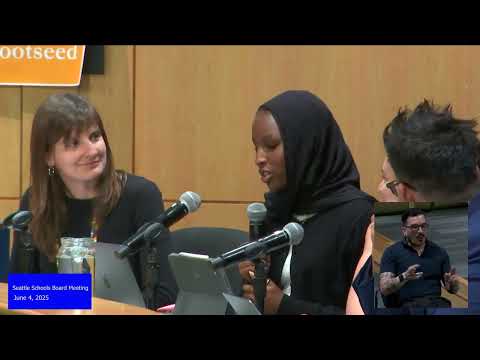
The Seattle School Board on June 4 heard an introduction to proposed revisions of several safety‑related policies, including firearms and weapons rules, emergency planning, the district’s relationship with law enforcement, and an updated policy (policy 4311) that would permit campus‑specific agreements for school engagement officers (SEOs).
Chief Operating Officer Fred Podesta said the package is intended to align district policy with recent state guidance, to consolidate several older rules into clearer policy and superintendent procedures, and to require detailed, limited agreements and annual reviews if any law‑enforcement presence were to be formalized. Podesta told the board the changes would not return policing to schools as a routine discipline tool: “This role is not about policing. It is not about school discipline,” he said, and any agreement would need to define and limit the officer’s role and contain training and oversight provisions.
Principal Terrence Hart, representing Garfield High School, urged the board to allow a narrowly defined pilot at Garfield that he said should emphasize relationship building, trauma‑informed practice and non‑disciplinary duties. “What I need is someone to come in and build relationships with students,” Hart said. He described multiple shootings and threats adjacent to Garfield in recent years and said prior SRO programs had included officers who were embedded and trusted by students.
Chief Accountability Officer Ted Howard framed the issue as a community‑rebuilding question: he said site‑based leadership, student voice, parents and community organizations must set the parameters at each campus. Howard asked the board to ensure any pilot included strong community engagement and documented accountability measures.
Public testimony at the meeting was heavily weighted toward student‑led and community groups. Several student and parent speakers urged the board to keep the 2020 moratorium in place and to invest in counselors and community alternatives rather than law‑enforcement presence; others, including some Garfield parents and students, said they support a trained, campus‑specific police presence outside or near campus. Student speaker Noah Funk told the board: “I strongly support the emplacement of SEOs outside of Garfield High School.” Student and advocacy group speakers repeatedly used the phrase “counselors, not cops” while others emphasized that if officers returned, an MOU should clearly strip officers of disciplinary authority.
Podesta and staff said the introduction is a step toward more detailed, campus‑by‑campus agreements that would require community input, training standards, and annual renewal or review. The policy text presented to the board calls for agreements that clarify the officer’s duties, limit their disciplinary role, and set oversight and training requirements; staff emphasized any final agreements would be shaped through campus engagement and negotiation with law enforcement.
The item was introduced for further board discussion and workshopping; no final board action was taken the evening of June 4.