Get Full Government Meeting Transcripts, Videos, & Alerts Forever!
Get email alerts on the Zoning Code topic
No spam. Unsubscribe anytime.
Maricopa County holds public workshop on overhaul of unincorporated zoning code
Summary
Tom Ellsworth, director of the Maricopa County Planning and Development Department, opened a June 5 stakeholder meeting in downtown Phoenix saying: "What we're here to discuss is the zoning code update for Maricopa County."
Tom Ellsworth, director of the Maricopa County Planning and Development Department, opened a June 5 stakeholder meeting in downtown Phoenix saying: "What we're here to discuss is the zoning code update for Maricopa County." He told about a hundred in-person and numerous online attendees that the effort focuses on unincorporated parts of the county, county islands and growth edges, not incorporated municipalities.
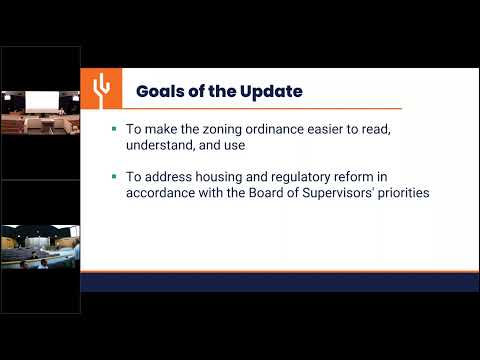
The county is aiming to modernize an ordinance first adopted in 1969, Ellsworth said, and to make the document easier to read and apply. "Maricopa County zoning ordinance was first adopted in 1969," he said, adding the code is "very text heavy" and contains inconsistent standards that staff want to clarify and streamline.
Why it matters: the county says the update is intended to increase clarity for landowners, reduce routine variances and introduce tools to support housing availability, including "middle housing" (duplexes, triplexes, townhomes) and revised rules for accessory dwelling units. Ellsworth said the board of supervisors appointed a multi-stakeholder task force of planners, developers and community members to advise the work.
Key timeline and public input: Ellsworth said staff will take the summer to incorporate stakeholder feedback, post a draft by Aug. 28, aim for a Planning and Zoning Commission hearing on Nov. 6 and a Board of Supervisors hearing near the end of December. A public questionnaire tied to the meeting will remain open through July 16; staff asked attendees to use it to submit more detailed comments.
Focus areas discussed: staff framed the update around four to five topic areas: allowed uses and zoning districts, development standards (setbacks, heights, lot coverage, parking), permitting and administrative procedures, and quality-of-life considerations such as buffers and transitions between uses.
On uses and emerging sectors: Ellsworth and staff listed several land uses not cleanly addressed in the existing code, including short-term rentals, food trucks and mobile vendors, electric vehicle charging and large utility uses such as data centers, large-scale solar and battery energy storage systems (BESS). Ellsworth said short-term rentals currently lack a land-use category in the county code, and that "state statute clearly says we can't prohibit short term rentals." He also noted the state's recent accessory dwelling unit legislation that allows one attached and one detached ADU and that counties are watching how those rules apply locally.
On development standards: staff discussed inconsistencies such as step-back rules and an example rural district with a side setback arrangement that differs from common practice. Ellsworth noted one rural district's lot-coverage cap of 10 percent and said staff is considering whether different standards should apply in urbanized county islands versus very rural areas. He also raised building-height questions: some industrial developers in the region are building to 50'52 feet while older county limits remain lower; one private custom homebuilder raised the need for higher residential heights to accommodate 9'10 foot ceilings.
Parking and specialized uses: staff and commenters described large mismatches between traditional parking ratios and the needs of modern uses such as data centers. A county staff example: applying a warehouse parking ratio to a low-staff data center would lead to excessive paved areas. Multiple speakers urged the county to allow administrative flexibility and parking studies to align parking requirements with demonstrated demand.
Permitting and administrative process: speakers from neighboring jurisdictions and several private-sector commenters recommended administrative tools to shorten timelines and reduce the need for variances and rezonings. One example from an outside planner: Queen Creek has a planning administrator authority that grants a 10% deviation to development standards; that tool was described as useful to meet market needs without a full public hearing.
Public-comment highlights: Jack Gilmore of Gilmore Planning suggested adopting a landscape ordinance and recommended a higher industrial height standard with perimeter setbacks for large parks. Ty Hutton asked about energy projects and whether the county intends to update standards for solar and BESS; Ellsworth said large utility solar has been treated as industrial and that the county has recommended development standards for BESS that are not yet codified. Residents and stakeholders across comments asked for clearer, more user-friendly wording, more time and better notification for site postings, and better interdepartmental coordination (for example, between flood control, transportation and planning reviews).
Administrative clarifications offered at the meeting: staff said initial zoning comment turnaround for reviews is typically about two to three weeks and that the department aims to streamline administrative processes. Ellsworth reiterated that the project team will post drafts online, call out changes against existing code and hold a follow-up stakeholder workshop when the draft is available.
What the county will not and cannot do: Ellsworth reiterated the county's obligation to follow state law when applicable, citing state statutes that affect short-term rentals and recent ADU legislation. He said the update seeks to implement flexibility "inside of our own code" while honoring statutory constraints.
Next steps and how to participate: staff asked stakeholders to complete the online questionnaire, review the August draft when it posts, and plan to attend the public hearings later in the year. Ellsworth closed by thanking attendees and restating the county's goal: to modernize format and increase code flexibility while maintaining neighborhood character.
Ending: The county will post the draft code and outreach materials online ahead of the August stakeholder meeting, encourage written comments through the online questionnaire (open through July 16) and pursue the stated hearing timeline later in 2024.