Get Full Government Meeting Transcripts, Videos, & Alerts Forever!
Get email alerts on the Budget And Staffing topic
No spam. Unsubscribe anytime.
Marion County board backs central office staffing revisions and five budget moves as district faces funding gap
Summary
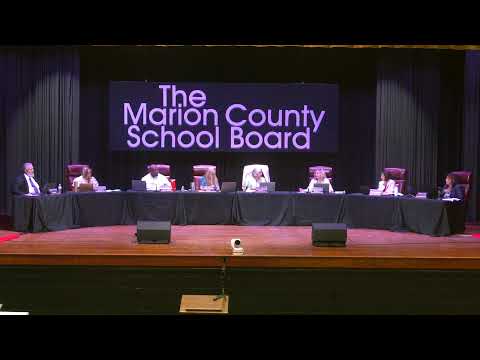
Marion County Public Schools leaders laid out a package of staffing changes and budget recommendations at a June 5 work session aimed at closing a large projected shortfall for fiscal year 2025–26, and the School Board signaled consensus to implement the plan and five targeted reductions.
Marion County Public Schools leaders laid out a package of staffing changes and budget recommendations at a June 5 work session aimed at closing a large projected shortfall for fiscal year 2025–26, and the School Board signaled consensus to implement the plan and five targeted reductions.
District finance director Kayla Boston Ellis told the board the district currently estimates a general-fund ending fund balance of about $66,000,000 and projected revenues of roughly $483,000,000 under the third state funding calculation; staff also warned the third calc could change when the fourth is released. Boston Ellis said the district’s unadjusted gap — before the staffing and program recommendations discussed at the work session — was in the tens of millions of dollars and that staff currently calculate a needed reduction near $64.3 million prior to other adjustments.
Whitehouse and staff proposed a suite of actions to reduce that gap. Chief recommendations presented at the work session are: release 50% of the district’s committed ("rainy day") fund balance (estimated at about $7.4 million); eliminate the 7-period day at three middle-school sites (roughly 13 teaching positions, about $1.2 million in savings); adjust ESOL paraprofessional staffing ratios (estimated savings about $530,000); change special-needs paraprofessional ratios, principally by assigning paraprofessionals at a lower rate to inclusion teachers (estimated savings about $4.7 million); and increase class-size ratios across grades by two students (estimated savings roughly $12,560,000). Whitehouse said the five recommendations together would reduce the district’s gap substantially; staff estimated that after those measures and other reductions there would still be about $9 million remaining to find to balance the budget.
Boston Ellis described several drivers behind the budget pressure. She said the family empowerment scholarship program has increased rapidly and unpredictably and now accounts for about $52,000,000 in allocation impacts for Marion County in the most recent counts; those scholarship dollars are distributed to families or private schools and generally do not flow back to the district if a student returns. Boston Ellis also reviewed the district’s ESSER-era staffing and spending, noting that some positions funded temporarily out of federal relief were moved into the general fund during budget crossovers, creating recurring obligations. She said the district must be careful not to fund recurring salaries with short-term grants.
Human-resources director Morant reviewed central-office staffing changes since the May 22 draft. She said more than 30 previously proposed central-office positions had been cut or unfunded since May, including vacant roles and items staff judged nonessential; the revised central-office staffing plan reflects about 55 fewer positions than the plan approved last year and moves several school-level positions out of the central-office schedule for clarity. Morant said many of the positions recommended for removal were vacant and that the district will bring job-description changes and other administrative items to the board for approval as needed.
Board members pressed staff on programmatic impacts. Several members said they were most concerned about cuts that would affect special education paraprofessionals and kindergarten paraprofessionals, and asked staff to prioritize students with highest needs. Dr. Campbell and others asked for data and school-level staffing plans showing where units would move, and requested that staff provide principals’ updated staffing allocations when final decisions are made so board members can respond to constituent questions.
After discussion, the board signaled consensus to move forward with the revised central-office staffing plan and to implement the five recommendations described by staff. Superintendent Brewer and staff said they would continue to refine savings, monitor the state’s fourth funding calculation, and return to the board if additional actions are necessary. Board members emphasized that if the district’s fiscal picture improves, refunded dollars should be restored to reserves first.
What this means: Staff and board members framed the package as a mix of near-term choices to avoid layoffs that would immediately cut pay, and longer-term structural changes that may shift where and how services are provided. Several board members said they view the district’s committed fund balance as a true reserve and preferred to restore it as soon as possible if state revenues improve.
Next steps: Staff will bring finalized central-office staffing plan changes and related job descriptions to the board for inclusion in the July/August administrative and consent processes, continue budget adjustments across departments, and monitor the Legislature’s next funding steps and DOE counts.