Get Full Government Meeting Transcripts, Videos, & Alerts Forever!
Get email alerts on the Stormwater Infrastructure topic
No spam. Unsubscribe anytime.
Norman staff outline April flooding impacts and push for stormwater funding and repairs
Summary
City staff gave a detailed update on the April 2025 storms, catalogued widespread infrastructure damage, and urged the council to consider new funding and maintenance options including a stormwater utility, additional equipment and HOA outreach; several repair and bond projects were described but no formal council action was taken.
City public works staff gave the Norman City Council a detailed briefing on April 2025 storm events, widespread flooding and the stormwater infrastructure repairs and projects the city is pursuing.
“This year in April, we had 14.06 inches,” the presenter said during the briefing, noting the 30‑year April average is about 3.64 inches and calling the event a multi‑day storm from April 19 through April 30 that produced very high accumulation totals. The presentation said the event reached a 500‑year 30‑day accumulation in some gauges and produced multiple flash‑flood events and an EF‑1 tornado in the region.
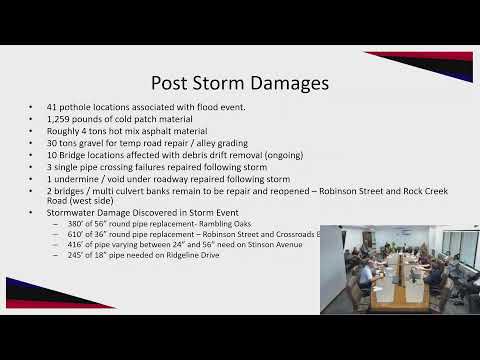
Staff catalogued both public and private impacts: roadway overtopping and closures across the city, collapsed and severely corroded corrugated metal storm pipes, a collapsed pedestrian bridge on Brookhaven Creek, damage to detention ponds and private infrastructure maintained by homeowners associations (HOAs), and isolated sewer failures where trees damaged lines. The presentation recorded 29 reports of personal property flooded or damaged, 24 incidents involving flooded or inaccessible driveways, and five flooded accessory structures (garages, sheds, patios); staff said the reported flooded locations were not within mapped flood plains.
Staff emphasized that a combination of saturated soils, undersized or aging infrastructure and deferred maintenance — including failing corrugated metal pipes in corrosive soils — contributed to the extent of damage. One example shown and discussed at the meeting was Robinson Street, where six 48‑inch corrugated metal pipes side‑by‑side had at least two complete failures. The presenter said the city is repairing those pipes with epoxy‑coated corrugated metal pipe immediately but views the site as a longer‑term bridge or box‑structure project.
Staff described recent and planned capital and maintenance responses: prior bond projects (2012 and 2019 bond programs) that raised roadways and replaced structures on Main Street, Franklin Road and Lindsay/McGee; buyouts of repetitive‑loss homes (two properties cited as examples) that the city converted to deed‑restricted open space; the Porter Avenue bridge replacement and other bridge bond projects; and a Summit Lakes dam project for which the staff said the total project budget is being finalized and that a $1.15 million grant award has been secured toward that work while other matching funds are in place.
Staff repeatedly urged more steady local funding for maintenance and equipment. They said the city still lacks the additional street sweepers and operations personnel proposed in earlier stormwater utility plans; without a dedicated stormwater utility the city must absorb additional maintenance costs in existing departmental budgets. The presenter also highlighted a neighborhood assistance concept previously funded at about $200,000 per year that could be repurposed to assist HOAs with detention‑pond maintenance or small repairs.
Council members and staff discussed several next steps and policy questions: whether to pursue a stormwater utility fee to fund ongoing maintenance and equipment replacement; whether the city can require HOA officers to receive training or to certify that detention infrastructure is maintained (city legal will research legality of a certification requirement); and how to build a GIS layer of HOA boundaries and recorded maintenance obligations so the city can communicate with responsible parties more quickly during emergencies.
Staff did not ask the council to take an immediate vote on new fees or projects at this meeting. Instead, they recommended further study, the preparation of survey materials and coordination with the city’s upcoming council retreat to set priorities. The briefing included multiple requests for additional funding and suggested the council consider bond and utility funding options at a future date.