Get Full Government Meeting Transcripts, Videos, & Alerts Forever!
Get email alerts on the Shopping Carts topic
No spam. Unsubscribe anytime.
Norman committee outlines phased plan to reduce abandoned shopping carts, emphasizes outreach
Summary
City staff and police described a multipronged approach including Walmart cart labeling, a proactive outreach team, an education campaign and limited enforcement beginning Aug. 1 to reduce abandoned shopping carts that burden city services and pose safety and health risks.
City of Norman staff and police told the City Council Business and Community Affairs Committee on June 5 that the city will begin a phased program to reduce abandoned shopping carts — combining retailer cooperation, outreach to people experiencing homelessness, an education effort and targeted enforcement.
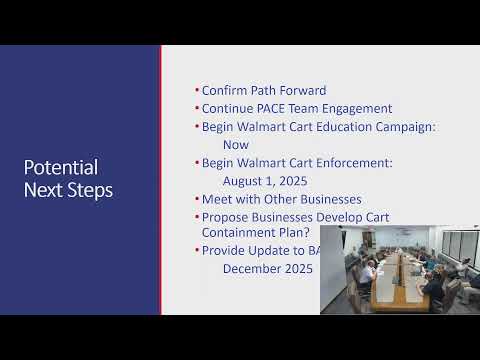
The committee heard that Walmart has agreed to place identifying signs on carts that include the store address so staff and contractors can return carts more quickly, and that the city will run an education campaign for roughly six weeks before limited enforcement begins Aug. 1. Assistant City Manager Shannon Stevenson, who presented the plan, said the goal is to address "the 10 carts, the ones that are a problem that are near drainage areas," while prioritizing compassionate outreach for people who use carts to store their belongings.
Committee members were told the issue affects many city departments — police, parks, utilities and stormwater — and that carts abandoned near drainage and waterways create costly cleanups and public-health concerns. Stevenson said about 90% of problematic carts observed citywide are from a single large retailer and that the city has worked with that retailer to improve response times. "They have agreed to start adding signs to all of the carts in Norman," Stevenson said. "It will have an address, so we'll actually know what store the cart goes to." She said some signage rollout may begin the week following the meeting.
Lieutenant Lee McWhorter described the police Department's PACE (Proactive Community Engagement) team and its work pairing outreach and enforcement. "We recently added a couple months ago folks that started doing proactive community engagement," McWhorter said. "The purpose of that is to build relationships and to try to work a problem from a holistic angle." McWhorter and other staff described repeated on-scene outreach efforts, coordination with local nonprofits and a property-custody process that gives people a receipt and 90 days to reclaim belongings booked into evidence custody.
The committee discussed enforcement limits and alternatives. Staff said municipal code 24-5-01 (interference with property use) can be used to issue citations and that enforcement will not be an immediate, punitive sweep. Rather, staff will prioritize education and outreach, and enforcement will focus on repeat or egregious cases. Stevenson said staff plan internal training so officers apply discretion and offer three options when officers recover belongings: (1) the person signs an affidavit relinquishing items; (2) staff inventory and store selected items in a tote for retrieval; or (3) the person accepts the cart and selected items and departs.
Council members asked about measurable outcomes. Staff said they will track metrics such as monthly cart recoveries (staff estimated roughly 25—60 carts per month, often concentrated in single incidents), stormwater removals and citation numbers, with the aim of seeing a sustained decline after enforcement. The committee also requested staff return with a plan to work with the city's major retailers to develop "cart containment plans" (hourly lot sweeps, end-of-day collection, or other feasible measures) before pursuing more prescriptive rules such as geofencing or mandatory containment infrastructure.
Committee members and staff discussed service alternatives when enforcement is used. The city noted an existing community docket that allows alternative sentences and credits for engagement with social services, and staff described ongoing talks and an MOU with Community Mental Health (COCMH) and mobile crisis services to divert noncriminal mental-health calls away from police.
Stevenson asked for committee direction to begin outreach to businesses about containment plans; the committee agreed. Staff emphasized the goal of reducing cost and safety burdens on city departments while maintaining outreach and humane responses to people who rely on carts for personal belongings.
The committee did not take a formal vote. Staff will proceed with retailer meetings, a public education rollout, continued PACE outreach, and a phased enforcement approach with internal training and measurable metrics.