Get Full Government Meeting Transcripts, Videos, & Alerts Forever!
Get email alerts on the Transportation Safety topic
No spam. Unsubscribe anytime.
Tucker study recommends $12.7M of safety and trail work, short-term fixes earmarked in FY26 budget
Summary
A corridor study of Hugh Howell Road presented to the Tucker Mayor and Council outlines 68 recommendations — from signage and school-flasher upgrades to a $1.75 million Rosser Road realignment — and proposes using a $1 million FY26 line item for near-term safety work while designing longer-range projects.
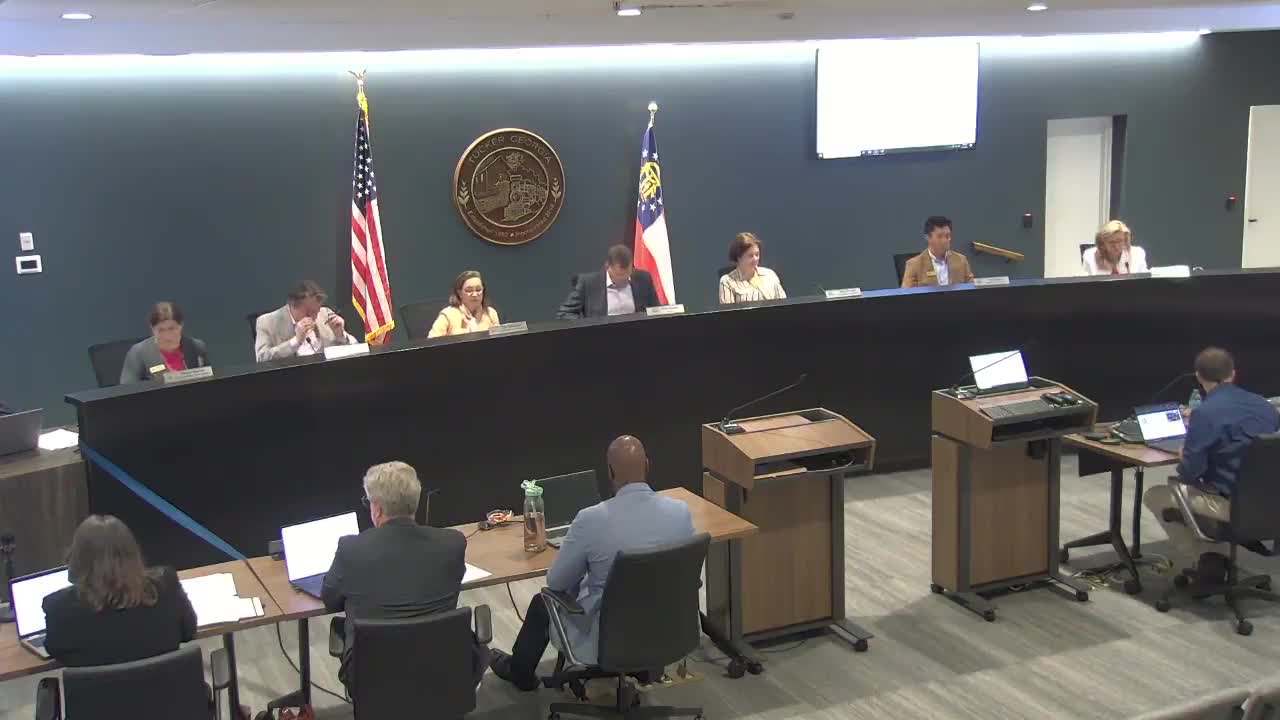
Ken Hildebrandt, a city planning presenter, delivered the Hugh Howell Road corridor draft report to the Tucker Mayor and Council, saying the study covers the entire corridor within the city from Mountain Industrial Boulevard to U.S. 78 and that it produced 68 recommendations covering small, maintenance and longer-range projects.
The study found daily traffic volumes ranging from about 11,000 vehicles per day on the east end to about 18,000 near Mountain Industrial Boulevard, and reported 346 crashes on the corridor in the previous five years, including 179 injuries and three fatalities. Hildebrandt said the corridor’s 80th‑percentile speeds measured about 48–49 mph in daytime hours and spiked in late-night hours, with recorded highs around 80 mph.
“These things combined are good safety improvements,” Hildebrandt said, describing lower-cost fixes such as enhanced warning signs and upgraded school flashers, and longer-range work such as realigning Rosser Road and adding roundabouts at Silver Hill Road.
Why it matters: Hugh Howell is a primary connector between downtown Tucker and Stone Mountain and passes residential neighborhoods and Smoke Rise Elementary School; the study’s recommendations aim to reduce crashes and improve pedestrian access while balancing traffic flow.
Most important recommendations and near-term funding
The consultant (Kimley-Horn) grouped the 68 recommendations into three tiers. City staff recommended using a $1 million line item included in the proposed FY26 budget to complete a bundle of “low-hanging fruit” —maintenance items, improved school flashers, advanced warning signs, targeted pavement markings and small curb/island installations to prohibit left turns where appropriate — and to initiate design work on several larger projects.
Longer-range projects identified in the report include continuing a multi-mile trail along Hugh Howell Road (estimated separately at about $5.6 million), a Rosser Road realignment estimated at about $1.75 million, new left-turn lanes (for example, onto Kanawha Drive), and double roundabouts at Silver Hill Road as a tier-3, higher-cost option. Excluding the trail, the study’s total estimated cost is roughly $12.7 million; including the trail brings the total to about $18 million, the presenter said.
Traffic, speed control and coordination with other agencies
Hildebrandt emphasized that some actions require coordination with Georgia Department of Transportation (GDOT) and DeKalb County, including any formal change in posted speed limits and some intersection improvements that affect state-owned facilities. He also said staff will seek about $400,000 in GDOT minor-safety funding to help implement a subset of the smaller recommendations.
Council members asked about speed-control options and timing. Hildebrandt noted that a detailed speed‑study would be needed to justify reducing the posted limit (for example, from 45 to 40 mph) and that any regulatory change would require GDOT and DeKalb County approvals. He also said a traffic-signal warrant analysis for the Rosser Road realignment could be completed as part of intersection design and estimated the standalone warrant analysis at under $20,000; full intersection design could be “less than a couple hundred thousand” depending on scope.
Discussion vs. decision
Council members and staff repeatedly framed the presentation as a planning step. The council directed staff to bundle and pursue the lower-cost items with the FY26 million-dollar allocation and to begin engineering design and traffic analyses for higher-cost options. No final construction decisions were made at the meeting; Hildebrandt said individual projects and design contracts would be brought back to the council for approvals and bid awards.
Community concerns and implementation notes
Council members and residents raised safety concerns about nighttime speeding and “takeovers” at the Lilburn–Stone Mountain intersection; staff acknowledged the measures will not stop all deliberate high-speed behavior but argued a combination of signage, striping, targeted physical changes and enforcement can reduce crashes. Staff also said DeKalb County plans to replace a water line on portions of the corridor and coordination will be required to avoid schedule conflicts on trail construction.
What’s next
Staff will use the FY26 $1 million line item to implement several lower-cost recommendations and start design on selected larger projects, pursue available GDOT safety funding, and return to the council with project-level designs, costs and requests for any required rights-of-way or construction funding.