Get Full Government Meeting Transcripts, Videos, & Alerts Forever!
Get email alerts on the Federal Grant Personnel Development 84.325K topic
No spam. Unsubscribe anytime.
U.S. Department of Education details $6 million grant competition to train personnel for children with high‑intensity disabilities
Summary
The Office of Special Education Programs outlined application requirements, deadlines and funding limits for a discretionary grant (Assistance Listing 84.325K) to prepare interdisciplinary early intervention, special education and related‑services personnel to serve children with high‑intensity needs.
Sanyoung Ahn, a project officer at the Office of Special Education Programs (OSEP) at the U.S. Department of Education, presented an information session on a discretionary grant competition for preparing interdisciplinary personnel to serve children with high‑intensity disabilities.
The notice inviting applications for Assistance Listing 84.325K was published in the Federal Register on May 27, 2025, and "All applications are due on 06/26/2025, no more no later than 11:59 and 59 seconds in the evening," Ahn said during the webinar, noting that the deadline is Eastern Time and that applicants should confirm the corresponding time in their time zone.
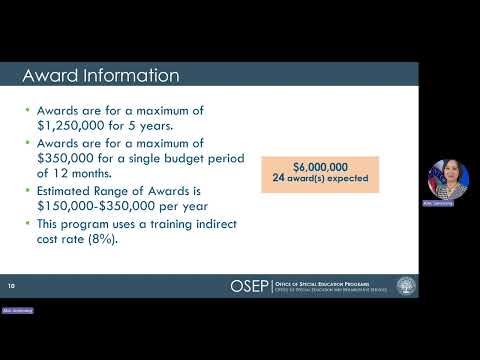
The grant competition, labeled the "3 to 5 Ks" priority during the presentation, makes $6,000,000 available and may fund up to 24 awards. Each award may not exceed $1,250,000 for a total project period of up to 60 months; the maximum award for a single 12‑month budget period is $350,000. OSEP allows applicants to use up to the first 12 months and up to $100,000 of the first budget period for planning.
Why it matters: the priority aims to increase both the number and the quality of early intervention, special education, and related‑services personnel who are fully credentialed to serve children with disabilities who have high‑intensity needs. Ahn said the priority funds interdisciplinary projects that prepare scholars at the master’s, educational specialist, or clinical doctoral levels and that 65% of each award, at a minimum, must be used for scholar support over the project period.
Applications and eligibility: Ahn said eligible applicants include institutions of higher education (not a department or program within an institution) and private nonprofit organizations that have legal authority to enter into grants on behalf of an IHE. Programs at the bachelor’s degree level may qualify for this priority only if they prepare educational interpreters for the deaf; bachelor’s programs are exempt from the interdisciplinary requirement but cannot provide scholar support during the first two years of a bachelor’s degree program.
Required materials and evaluation: the application instructions and the notice spell out five narrative sections that mirror reviewers’ selection criteria: significance (up to 10 points), quality of the project design (up to 35 points), quality of the management plan (up to 20 points), adequacy of resources (up to 20 points), and quality of the project evaluation or evidence building (up to 15 points). Ahn summarized those sections and noted tiebreakers: if two or more applications tie in total score and funds are insufficient, reviewers will use scores for quality of the project design as the first tiebreaker and adequacy of resources as the second.
Application content and attachments: applicants must include Appendix A (charts, tables, figures and a letter of support from a partnering agency, school, or program that will provide field or clinical experiences in specified high‑need settings) and Appendix B (a table listing required coursework and four exemplar syllabi). The project must meet statutory requirements in section 662(e)–(h) of the Individuals with Disabilities Education Act (IDEA), Ahn said, and grantees must collect and submit annual scholar data and other performance reports to track service‑obligation fulfillment.
Administrative details and limits: Ahn said the program uses a training indirect cost rate of 8% and that scholar support may include tuition and fees, health insurance, allowances for books and supplies, dependent care, transportation, room and board, travel for training, and stipends. She reiterated that the Department will not fund proposals that do not address the stated priority (for example, professional development for childcare staff would not be eligible) and warned that applications received after the deadline or that are substantively the same as proposals submitted under a different assistance listing may be ineligible.
Submission advice and contacts: applicants must submit electronically through Grants.gov. Ahn advised applicants to register early, submit PDFs in read‑only format to reduce processing issues, and confirm Grants.gov validation and time stamps. She provided an email (sanyoung.ahn@ed.gov) and a phone number ((202) 987‑0141) for further questions.
Ahn closed the session by reminding prospective applicants to read the full notice and application instructions for detailed requirements and scoring rubrics before applying.