Get Full Government Meeting Transcripts, Videos, & Alerts Forever!
Get email alerts on the Special Education Grant Competition topic
No spam. Unsubscribe anytime.
U.S. Education Dept. details June 26 deadline, priorities for special-education leadership doctoral grants
Summary
The Office of Special Education Programs held a webinar explaining application requirements, deadlines and review criteria for a discretionary grant to prepare doctoral-level special education and early intervention leaders; applications are due June 26, 2025, by 11:59:59 p.m. Eastern.
Celia Rosenquist, a project officer at the Office of Special Education Programs (OSEP) at the U.S. Department of Education, outlined application requirements, deadlines and review criteria on a webinar for a discretionary grant competition to prepare special education and early intervention administrators.
The notice inviting applications for the competition was published in the Federal Register on May 27, 2025, and "all applications are due on Thursday, 06/26/2025, no later than 11:59 and 59 seconds in the evening," Rosenquist said, adding that the deadline is Eastern Time and that applicants should confirm the corresponding time zone for their submission.
The competition targets doctoral-degree programs that train personnel to serve in leadership roles — examples Rosenquist gave include "special education administrators, special education directors, school-based special education directors, preschool coordinators and early intervention coordinators." She said OSEP anticipates making six awards to individual institutions of higher education, though the total number could vary depending on partnership applications.
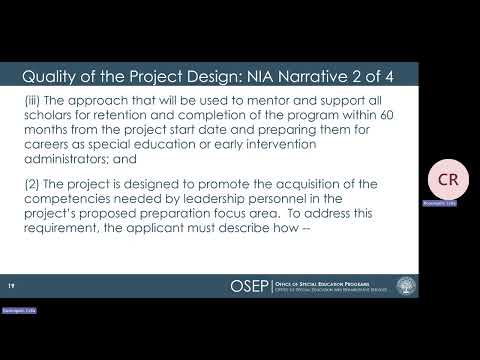
Applicants must follow the notice and the application instructions on grants.gov. Rosenquist said the application narrative should be divided into five sections that match reviewer selection criteria: significance; quality of project design; quality of the management plan; adequacy of resources; and quality of the project evaluation or other evidence building. She summarized point values: significance up to 10 points; project design up to 35; management plan up to 20; adequacy of resources up to 20; and evaluation up to 15, for a total of 100 points, not counting competitive preference priority points.
Two competitive preference priorities are available: one for historically Black colleges and universities and minority-serving institutions (0 or 3 points) and one for new potential grantees (0 or 5 points). Rosenquist defined a "new potential grantee" as an applicant that "has not had or been part of an active discretionary 325(d) or 325(h) grant in the last five years." She also noted that if two applications tie and funds are insufficient to fully fund both, reviewers first use scores under quality of project design as a tiebreaker, then adequacy of resources if needed.
Budget and program requirements Rosenquist highlighted include a training indirect cost rate of 8 percent, and an assurance that at least 65 percent of the total award will be used for scholar support. Scholar support may include cost of attendance, travel and stipends and "does not need to be uniform for all scholars"; applicants should customize support based on individual scholars' financial needs and project projections should consider tuition and cost-of-living increases over the project period.
Rosenquist said projects must describe how they will recruit and retain scholars, how mentoring and supports will enable completion within 60 months from project start, and how project components will develop leadership competencies. For partnership proposals, she said partnerships must include two or three IHEs with doctoral programs and provide joint experiences each year so scholars gain competencies by engaging with faculty and scholars at each participating IHE.
OSEP requires certain assurances in the application, Rosenquist said, including compliance with IDEA statutory requirements (section 662 e through h), federal civil rights laws, accessible websites if a project has one, annual reporting of scholar accomplishments, and that scholar support will not be conditioned on scholars working for the grantee. Rosenquist also said applicants should budget for the project director to attend a two-day project directors meeting in Washington, D.C., each year of the project.
On submission logistics, Rosenquist advised applicants to register on grants.gov well before the deadline and to submit early to allow time for upload and validation. Grants.gov places a timestamp and validates submissions; if an application is submitted and validated more than once, the last validated submission will be considered. Applications submitted after the published deadline or that do not address the priority (for example, proposing a tutoring or after-school program) will be ineligible.
"This webinar provides a general summary of the information contained in the notice inviting applications and the application instructions," Rosenquist said, urging prospective applicants to read the full notice and instructions. She provided an email (ciliaperiodrosenquist@ed.gov) and phone number ((202) 245-7373) for additional questions.
Applicants should consult the full notice inviting applications and the application instructions on grants.gov for complete details about funding limits, required forms, appendices and other application requirements.