Get Full Government Meeting Transcripts, Videos, & Alerts Forever!
Get email alerts on the Higher Education Special Education Grants topic
No spam. Unsubscribe anytime.
Education Department opens $4.5 million competition to prepare special-education personnel at HBCUs, tribal colleges and MSIs
Summary
The U.S. Department of Education's Office of Special Education Programs held a pre-application webinar for CFDA 84.325M, outlining eligibility, funding limits, scholar-support rules and application requirements; applications are due June 26, 2025, at 11:59 p.m. Eastern.
The U.S. Department of Education's Office of Special Education Programs held a pre-application webinar to summarize the Notice Inviting Applications (NIA) for CFDA 84.325M, a competition that provides $4,500,000 total and is expected to fund about 18 awards to prepare special-education, early intervention and related-services personnel at Historically Black Colleges and Universities, tribal colleges and other minority-serving institutions. Tracy Dixon, competition manager for the program, led the presentation and repeatedly cautioned that the webinar is informational only and does not replace the NIA.
Why this matters: the 84.325M grants aim to increase the pipeline of certified personnel who provide services to children with disabilities. Successful grants may provide up to $350,000 per year for as many as five years (not to exceed $1,250,000 total) and must dedicate at least 65% of the award over the project period to scholar support.
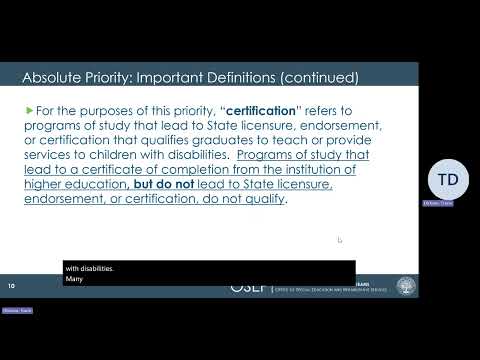
Details of eligibility and funding: Dixon said eligible applicants are institutions of higher education (the IHE itself, not a department or project director) or nonprofit organizations that can legally apply on behalf of an IHE. The competition funds degree and certification programs at the bachelor's, master's, educational specialist or clinical doctorate levels and programs that lead to state licensure, endorsement or certification. The department will not fund substantially similar projects from the same institution across the 84.325K and 84.325M competitions; an IHE may submit only one application to this competition.
Application and deadlines: the NIA was published in the Federal Register on May 27, 2025; applications must be submitted electronically through Grants.gov by 11:59 p.m. Eastern on June 26, 2025. Dixon emphasized, "The information that I am about to present is for guidance only and cannot replace the notice inviting applications," and warned applicants to register early on Grants.gov because registration can take seven to ten business days or longer.
Scholar support and program requirements: at least 65% of the total award must be used for scholar support; Dixon said scholar support may include tuition and fees, health insurance, books and supplies, stipends, dependent-care allowances and travel related to training. For projects that prepare personnel at the bachelor's level, scholar support cannot be provided during the first two years of the degree program. Projects proposing a planning year may use up to $100,000 of the first budget period for planning, but must ensure the 65% scholar-support requirement is met after accounting for planning funds.
Selection criteria and required materials: applicants must address five selection criteria: significance (up to 10 points), quality of project design (up to 45 points), management plan (up to 20 points), adequacy of resources (up to 10 points) and project evaluation/evidence building (up to 15 points). Required assurances include adherence to IDEA statutory requirements, service-obligation provisions, and submission of a table of required coursework plus four exemplar syllabi that reflect evidence-based practices. Dixon reminded applicants that scholar-support costs must not be conditioned on scholars working for the university.
Competitive preferences and limits: competitive preference priority 1 awards five points to projects implemented by or in partnership with HBCUs or tribal colleges as defined in the NIA. Competitive preference priority 2 awards five points to applicants that have not had an active 84.325K, 84.325M or 84.325R grant in the last five years. A grant is considered active through the end of its funding period, including extensions.
Administrative and reporting requirements: funded projects must attend an annual project directors meeting (typically in summer), participate in cross-project collaboration, meet annual scholar-data reporting requirements and ensure project websites are accessible. Dixon also emphasized general requirements to involve and employ individuals with disabilities and to ensure equitable access.
How applicants should prepare: Dixon advised reading the entire NIA and the application instructions on Grants.gov, including all footnotes and links, because the webinar covers only a summary. "This webinar does not replace the NIA," she said, adding that applicants should submit PDF read-only attachments and verify successful Grants.gov submissions well before the deadline.
Closing note: Dixon offered to answer questions by email and urged applicants not to assume details from past competitions apply this year. "Don't wait. Don't try to make assumptions. If you have a question ... I will be happy to help you," she said.