Get Full Government Meeting Transcripts, Videos, & Alerts Forever!
Get email alerts on the Community Development Block Grant topic
No spam. Unsubscribe anytime.
Bozeman board backs CDBG FY2025 action plan, urges priority for emergency and transitional housing
Summary
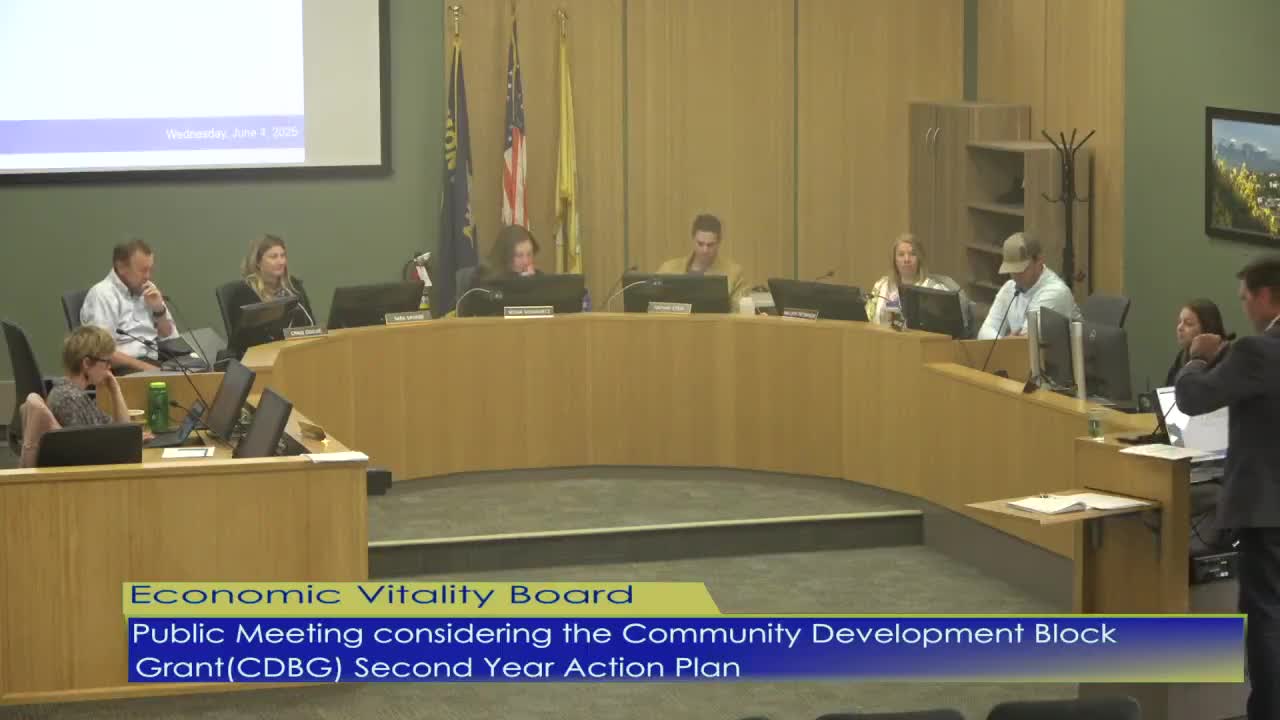
The Bozeman City Economic Vitality Board voted to recommend the City Commission approve the federal Community Development Block Grant (CDBG) FY2025 annual action plan and urged the commission to prioritize emergency and transitional housing funding and consider using administration dollars across program categories.
The Bozeman City Economic Vitality Board voted to recommend approval of the Community Development Block Grant (CDBG) FY2025 annual action plan to the Bozeman City Commission, and urged the commission to prioritize funding and resources for emergency and transitional housing.
The recommendation, approved by voice vote, asked the commission to prioritize emergency and transitional housing “relative to increasing and preserving housing options” and to consider whether planning and administration dollars could be used to support activities across the plan’s categories. The motion passed with a unanimous roll-call of board members present: Sarah Savage (yes), Nathan Sykes (yes), Craig Ogilvy (yes), Mallory Peterson (yes), Albert Jones (yes) and Vice Chair Schwartz (yes).
The board heard a presentation from Bridal Fontenot, the city’s economic development director and the board’s liaison to the commission, who reviewed background on Bozeman’s consolidated plan and the CDBG funding formula administered by the U.S. Department of Housing and Urban Development (HUD). Fontenot said Bozeman became an entitlement community in 2024 and that the consolidated plan is a five-year document that began last year.
Fontenot outlined available resources and targets. He said the city received $325,000 in CDBG funds in 2024 and anticipates an allocation of $347,000 for the next year, producing a cumulative pool of roughly $650,000 over two years to program under the action plan. Fontenot noted the city has not yet spent the year-one allocation and intends to carry those funds into year two for deployment.
On program priorities, Fontenot framed three broad categories in the draft action plan: emergency and transitional housing (identified as the board and public’s priority), critical community services (including mental-health and eviction-prevention activities), and planning/administration. He described staff preference to focus resources on a single larger project rather than many small projects to reduce administrative burden.
As a possible near-term capital project, Fontenot described a proposed partnership with Family Promise to extend sewer service to a recently expanded facility off Nineteenth Street. That extension would unlock eight family transitional housing units that are currently unusable for lack of sewer capacity. Fontenot said engineers’ estimates for the sewer work are “roughly $200,000 to under $300,000.” He described the Family Promise project as a candidate to absorb the unspent year-one allocation so the city meets HUD spending deadlines.
Board members raised questions about the size of the planning and administration set-aside (staff presented a two-year planning/administration total of about $134,000 and cited a prior-year administrative carryover figure of $65,171), the process for awarding funds to community partners (staff said they use Requests for Proposals), and whether some administration dollars could be redirected to program activities or partners. Several board members pressed staff to preserve or increase the allocation for emergency and transitional housing rather than moving money into “increasing and preserving housing options” without firm project plans.
Fontenot said some funds may be used to support a planned hire: the city is creating a housing manager position (upgraded from a housing coordinator) to manage the CDBG program and related housing work. He also said HUD requires regular reporting and that the city must spend the year-one allocation by the fall of next year (staff stated the deadline is around September or October). Fontenot cautioned that some proposed projects are contingent on technical, regulatory and annexation steps and that federal grant rules restrict how certain categories may be used.
After discussion, board member (name not specified in the transcript) moved to recommend the action plan, with language prioritizing emergency and transitional housing relative to the “increasing and preserving housing options” category and asking the commission to consider whether planning and administration dollars could support all three categories. Nathan Sykes seconded the motion. The board voted and the motion carried.
The board requested that staff present the action plan to the City Commission in August and to return with follow-up reports if projects—such as the Family Promise sewer extension or the Fowler for-sale project—advance. Fontenot said staff will work to provide clearer answers on administration-dollar eligibility and on project timelines prior to the commission hearing.
Votes at a glance: The Economic Vitality Board voted unanimously to recommend the Bozeman City Commission approve the CDBG FY2025 annual action plan with prioritization for emergency and transitional housing and consideration of administration dollars to support eligible activities across categories.