Get Full Government Meeting Transcripts, Videos, & Alerts Forever!
Get email alerts on the Voip Facilities Definition topic
No spam. Unsubscribe anytime.
CPUC workshop probes what counts as ‘facilities’ for interconnected VoIP providers
Summary
At a California Public Utilities Commission workshop, carriers and industry groups disputed whether ‘‘facilities’’ should mean last‑mile outside plant or include movable data‑center equipment, with stakeholders detailing how telephone numbers are hosted, the equipment involved, and who fixes outages.
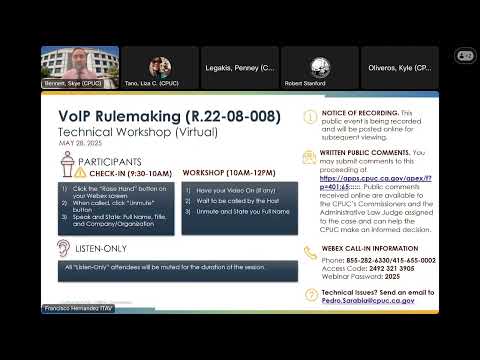
The California Public Utilities Commission on Tuesday convened a technical workshop for its VoIP rulemaking (R.22‑08‑008) to seek industry input on what physical or logical elements should be considered ‘‘facilities’’ for interconnected voice‑over‑Internet‑protocol (VoIP) providers and whether that definition would trigger additional state licensing or environmental review.
The issue matters because a narrower definition focused on outside‑plant last‑mile infrastructure would generally leave over‑the‑top VoIP providers outside of facilities‑based licensing, while a broader definition that reaches data‑center equipment or hosted platforms could prompt new state requirements, participants said.
Penny Legakas, communications‑division host for the CPUC, opened the workshop and described the roundtable format and post‑workshop written questions that will become part of the proceeding record. The session drew representatives from cable operators, facilities‑based carriers, over‑the‑top VoIP providers, and policy groups.
Voice and facilities distinction
Jonathan Marashlian, an attorney with Marashlian & Donahue representing the Cloud Communications Alliance (CCA), said the alliance’s members are largely ‘‘over‑the‑top’’ providers that do not own or control last‑mile networks. He urged the commission to limit ‘‘facilities’’ to infrastructure ‘‘in the ground, in the air, strung on poles’’ — i.e., last‑mile outside plant — and to treat other network elements as movable equipment. "Facilities as we understand them ... should only include the types of facilities that are in the ground, in the air, strung on poles, basically the last mile connectivity to the customer premise," Marashlian said.
Telnet president Mark Iannuzzi described how VoIP services link to two public networks: the public switched telephone network (PSTN) for phone numbers and the public Internet for IP packets. "There are 2 and only 2 public networks in the world. There's the classic PSTN ... and the public Internet," Iannuzzi said, and he said Telnet operates data centers outside California (Detroit and Atlanta) that connect to both networks.
Cable operators and facilities‑based carriers pushed back on any rule that would treat their existing, affiliate‑owned physical networks as requiring new CPUC authorization. Suzanne Toler, speaking for Comcast, said Comcast offers voice as an IP service over its broadband network and that the company's existing cable franchise (referred to in the workshop as the DIVCA franchise) already authorizes construction of the cable facilities needed to carry VoIP. "We believe that Comcast doesn't need any additional facilities‑based authority from the Commission to provide its VoIP services because we already have that authority basically from our DIVCA franchise," Toler said. Representatives for Charter and Consolidated Communications made similar points about using their affiliate network authorities to deliver voice.
Number hosting and required equipment
Participants described how telephone numbers are hosted and routed. Glenn Richards, an attorney with Dickinson Wright representing Voice on the Net Coalition, told the CPUC that an interconnected VoIP provider that hosts its own numbers would typically use a session border controller (SBC) to which routing is pointed; carriers then use the local number portability database and peering or middle‑mile providers to deliver calls to and from the PSTN. "The interconnected VoIP provider would typically need ... a what's called the session border controller," Richards said.
Stakeholders also described numbering management tools. Richards said number inventory and provisioning can range from simple spreadsheets to specialized queryable databases or in‑house tools hosted on redundant servers. Several providers said firms commonly host number databases or related services through third‑party vendors or through CLECs that provide middle‑mile termination and porting assistance.
Implications for licensing and CEQA
Multiple commenters urged the CPUC to align the definition of facilities with the kinds of physical work that trigger California Environmental Quality Act (CEQA) review — namely, ground‑disturbing or visible outside‑plant projects. Suzanne Toler linked the ‘‘facilities’’ notion to CEQA, saying CEQA is concerned with physical ground disturbance or aesthetic impacts and that a facilities definition tied to outside plant would be consistent with that concern.
Several over‑the‑top providers warned that a broadened California definition could prompt migration of movable equipment out of state. Marashlian said much VoIP infrastructure is mobile or hosted elsewhere and cautioned that too‑broad a definition could prompt providers to relocate equipment out of California.
Outages and public‑safety interconnection
Workshop participants noted that responsibility for fixing outages depends on where a failure occurs. Glenn Richards summarized that an outage might be caused by a customer‑premises power loss, a broadband provider problem, a CLEC/middle‑mile failure, a data‑center or VoIP operator issue, or other causes; identification of the root cause determines who must repair service. He also noted that some elements of 911 interconnection are operated by third‑party vendors and that, today, California’s 911 network remains largely TDM‑based, so VoIP providers typically rely on intermediaries to interconnect calls to public‑safety answering points (PSAPs).
No decisions adopted
The workshop was a fact‑finding roundtable; no votes or licensing decisions were taken. CPUC staff indicated that post‑workshop questions and written comments will be added to the record for the proceeding.
Why this matters
The CPUC’s definition of ‘‘facilities’’ for interconnected VoIP providers could change whether some providers must obtain additional state licenses or undergo CEQA review when building or modifying infrastructure. That in turn affects where providers host infrastructure, how telephone numbers and 911 connectivity are managed, and which entities are accountable for outages.
What comes next
An administrative law judge will issue post‑workshop questions and set a comment period in the rulemaking record; the workshop recording and presentation materials will be posted on the CPUC website for use in those filings.