
City and Frog Creek Partners move forward with gutter‑bin stormwater filtration MOU after public Q&A
Get AI-powered insights, summaries, and transcripts
Sign Up Free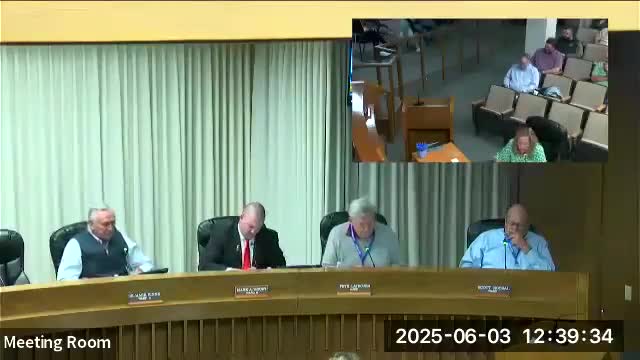
Summary
The Finance Committee recommended that the City Council approve an MOU with Frog Creek Partners to install and maintain donated gutter‑bin stormwater filters aimed at reducing pollution to Crow Creek.
The Finance Committee recommended that the City Council approve a memorandum of understanding (MOU) between the City of Cheyenne and Frog Creek Partners (Frog Creek Partners SCP LLC) to define responsibilities for installation and maintenance of donated gutter‑bin stormwater filtration units intended to reduce pollution to Crow Creek.
Tom Cobbs, city engineer, summarized the MOU and said it formalizes a commitment made by the governing body on Aug. 12, 2024 (resolution 64‑20) to enhance Crow Creek and to allow donated gutter‑bin installations. Cobbs told the committee the MOU will terminate on Dec. 31, 2035, and that he required third‑party testing from Frog Creek to demonstrate performance and clogging characteristics, with test results due within nine months of first installation.
Brian Derlow, president of Frog Creek Partners, spoke during public comment. “This project began with a single sponsor and 127 gutter bins and has since grown to 307 units,” Derlow told the committee. He said the project is funded by corporate sponsors who will cover long‑term maintenance and data reporting costs and that Frog Creek will manufacture and install the filters in Wyoming. Derlow also said Frog Creek was recently awarded a National Science Foundation grant to conduct hydraulic testing and to install sensors on a limited number of gutter bins in Cheyenne to measure total suspended solids and other parameters tied to Crow Creek’s TMDL.
Derlow asked for three changes to the MOU—permission to notify the city by phone and email as well as by written mail or in person, a 72‑hour response window for city approvals, and a change so termination would be “for cause” rather than allowing cancellation “for any cause.” City engineer Cobbs said the city was comfortable with phone or email for routine maintenance notifications but wanted written notice for major changes; he also said the city would “promptly review” installation schedules but declined to guarantee a specific 72‑hour timeline because review may involve multiple departments. The draft MOU includes a cure period and a process before the city may terminate for convenience: the city must notify Frog Creek of material concerns, Frog Creek has 30 calendar days to cure, and if unresolved the city may proceed to terminate upon 60 days’ written notice.
Committee members emphasized the broader need to maintain downstream wetlands and pump‑house wetlands to ensure the program’s effectiveness. With no additional public comment, the committee moved, seconded and unanimously recommended the MOU be sent to the full council with a recommendation to approve.
The MOU places installation and maintenance responsibilities with Frog Creek Partners, requires third‑party testing and reporting, and states that sponsors will cover ongoing maintenance and data costs; the city retains the right to require written notice for material changes and a cure period before termination for convenience.