
San Luis council receives Robert’s Rules training on points of order, quorum and consent agendas
Get AI-powered insights, summaries, and transcripts
Subscribe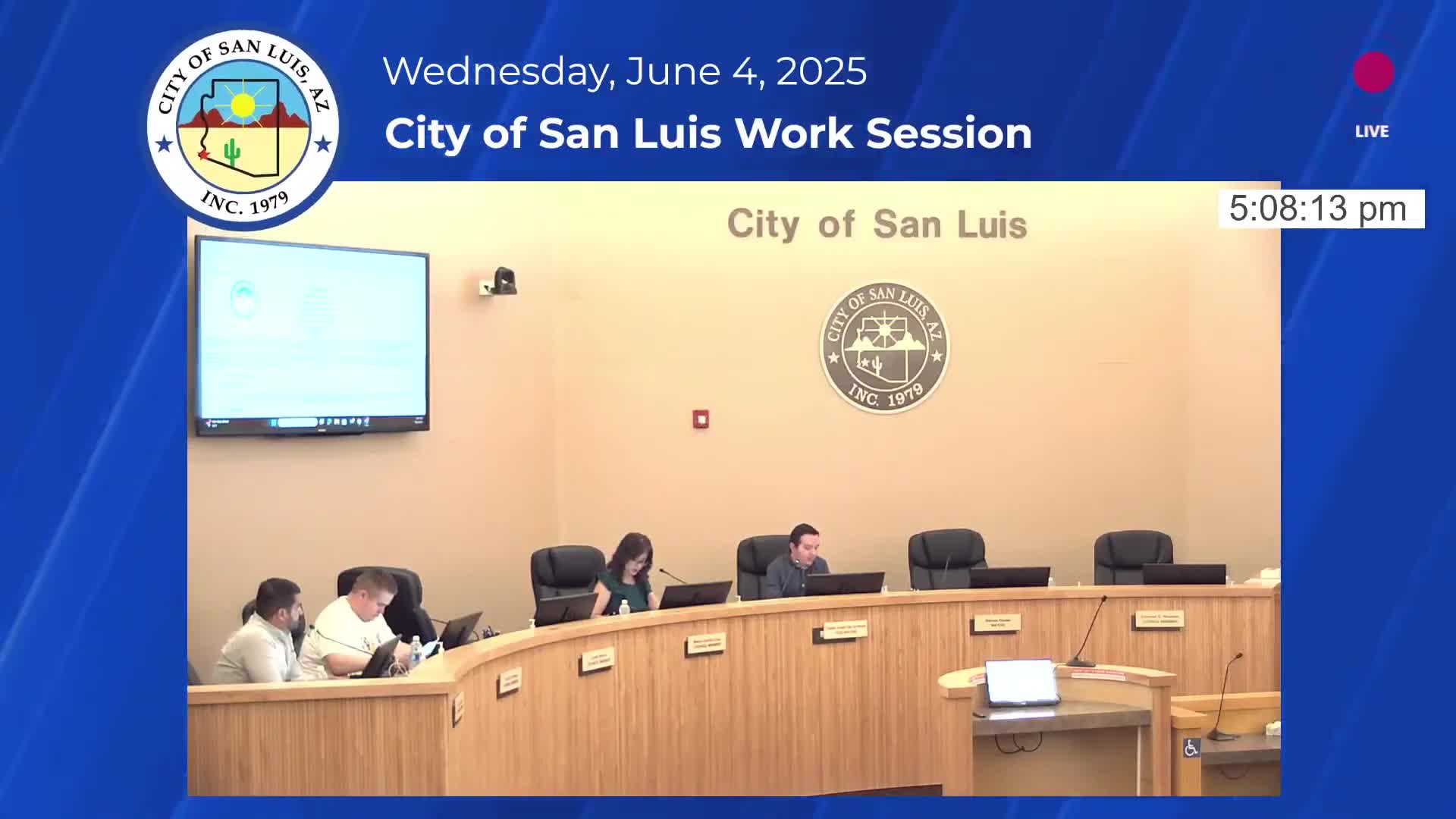
Summary
San Luis — Parliamentarian Tim Wynne of Perfect Rules Inc. led a video-conference work session on Robert’s Rules of Order for the San Luis City Council, beginning at 5:08 p.m. and adjourning at 7:07 p.m., to review how the council should handle motions, points of order, appeals, quorum questions and consent agendas.
San Luis — Parliamentarian Tim Wynne of Perfect Rules Inc. led a video-conference work session on Robert’s Rules of Order for the San Luis City Council, beginning at 5:08 p.m. and adjourning at 7:07 p.m., to review how the council should handle motions, points of order, appeals, quorum questions and consent agendas.
Wynne, who identified himself as “a professional parliamentarian,” told the council he was presenting from a hotel while traveling and used the 12th edition of Robert’s Rules of Order as his guide: “If there is no objection, $100 shall be donated to the ABC Foundation,” he said as an example of how unanimous consent works in practice.
The training mattered because council members raised real procedural questions they said had appeared in past meetings, including whether abstentions count toward a vote, how disqualification affects quorum, how to remove items from a consent agenda and what authority the chair has to rule motions out of order. Wynne repeatedly emphasized that Robert’s Rules provides default procedures that a body can alter only by adopting its own rules and that the chair’s rulings are subject to appeal.
Wynne covered several specific topics the council asked about: points of order and appeals, unanimous consent, how a chair should rule and explain rulings, and the distinction between quorum (who must be present) and vote requirements (how many votes are needed). He summarized the appeal process: after a member says, “I appeal from the decision of the chair,” another member must second the appeal and the assembly then votes on whether to sustain the chair’s ruling.
On quorum and votes, Wynne said a quorum allows the body to transact business but does not set the vote threshold: “The quorum is only who needs to be present,” he said, adding that vote requirements are determined separately. He explained that an abstention (a member present but choosing not to vote) generally does not count as a vote under Robert’s Rules, while a disqualified member (who lacks the right to vote on a matter) does not count toward the quorum for that specific question.
Council members pressed for local application. One council member described a recent regular meeting where a member present declined to vote and council staff told the body that the item did not pass despite a majority voting yes; Wynne replied that under parliamentary law a motion with a quorum present and a majority of votes cast in favor is adopted, and that disqualification (not voluntary abstention) is the circumstance that removes a person from quorum calculations.
Wynne also explained consent-agenda practice: the chair may adopt noncontroversial items en bloc but any single member can request that an item be pulled for separate consideration without a second. He cautioned, per Robert’s Rules, that if an item requires public notice the body must still meet notice requirements; placing something on a consent agenda does not remove notice obligations.
On compelling attendance, Wynne said the council’s municipal code language permitting the body to “compel the attendance of absent members” signals that the council can adopt a process for doing so, but Robert’s Rules does not prescribe the mechanics; the council would need to adopt more specific local rules to implement compulsion.
Technical issues disrupted the presentation briefly: Wynne lost and rejoined the meeting after an IT-related disconnect and staff helped display the PowerPoint. Council members asked for and were told they would receive a copy of the presentation.
No formal council motions or votes were recorded during the workshop portion of the meeting. Toward the end of the session council members indicated they would schedule a follow-up work session to cover material not reached because of time and technical delays; staff was asked to circulate the PowerPoint. The meeting was adjourned at 7:07 p.m.
The session was instructional and procedural; Wynne focused on clarifying how accepted parliamentary principles apply to the council’s routines and to questions the members had previously raised. Council members used the Q&A to seek rulings and practical guidance on how to record votes, when roll-call votes are appropriate, and how the chair should handle out-of-order motions.
Next steps: staff to provide the presentation slides to council members and to schedule a second work session to cover any remaining topics that were not reached during this session.