Get Full Government Meeting Transcripts, Videos, & Alerts Forever!
Get email alerts on the Board Governance Training topic
No spam. Unsubscribe anytime.
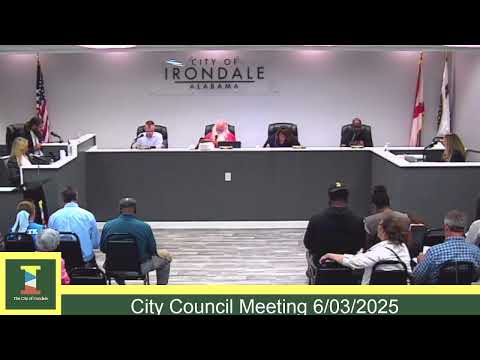
Irondale council debates two competing training guides for municipal board members; council agrees to collaborate and delay final adoption
Summary
The Irondale City Council debated two competing resolutions to establish a municipal board member training guide on June 3 and agreed to collaborate and postpone final adoption.
The Irondale City Council spent substantial discussion time on June 3 on two competing resolutions to establish a municipal board member training guide. Councilman Aaron Sims introduced a resolution (R99) to create a municipal board member training guide; Councilwoman McQuayre subsequently presented an alternative version (R103) that would make the guide part of the enabling resolution and remove references to commissions appointed exclusively by the mayor.
Key items in dispute included who could implement time‑sensitive changes to the training guide and whether the guide should be adopted as an exhibit to a single resolution. Sims's draft originally included wording that would have allowed the council president and the city attorney to approve revisions; after discussion the parties agreed to an amendment permitting the city attorney and the council president or designee to implement time‑sensitive changes as determined by the city attorney. McQuayre's alternate version struck references to the planning and zoning commission because commissioners are appointed by the mayor, not the council, and added material taken from Robert's Rules of Order outlining decorum and useful parliamentary phrases.
Rather than approve one of the two competing guides that night, council members agreed to collaborate and review both proposals in a work session. Councilman Box suggested passing a simple resolution committing the council to create a training guide and then reviewing an integrated draft in a work session; Sims and others signaled willingness to merge language. The council moved Sims's item to the consent agenda (so a formal guide would not be adopted that night) and agreed to hold a follow‑up meeting to finalize the text.
Why it matters: The discussion addresses how citizen board members are prepared for service and who controls training content and emergency edits. The council's decision to delay adoption and collaborate reflects concerns about centralizing authority in an individual office and about preserving the mayor's appointment authority for certain commissions.
Action: Item R99 (Sims's training‑guide resolution) was moved to consent for later finalization; R103 (McQuayre's version) was removed from immediate consideration pending collaborative review. Council members asked for a work session to produce one consolidated guide for future approval.
Attributions in this report come from the council dais during the deliberation on items 5 and 6.