Get Full Government Meeting Transcripts, Videos, & Alerts Forever!
Get email alerts on the Homelessness Services topic
No spam. Unsubscribe anytime.
Moses Lake council to close Open Doors sleep center; staff seeks public input on post-closure plan
Summary
Moses Lake city leaders confirmed the Open Doors Sleep Center will close when a state grant ends June 30 and solicited public feedback on a city-led plan that emphasizes enforcement, partnerships with nonprofits, and expanded outreach. Residents raised concerns about where unsheltered people will go, detox access and funding.
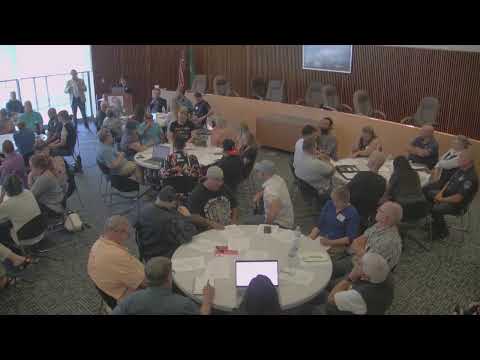
Moses Lake Mayor Dustin Swartz told a packed June 3 town hall that the City Council has decided not to renew funding for the Open Doors Sleep Center when the state grant that supports it expires on June 30.
"After reviewing the impacts and costs, the council has decided not to renew funding for the sleep center when the state grant expires at the June," Swartz said, explaining the decision grew out of council review of program outcomes and costs.
The decision matters because the center, run with subcontractor HopeSource, has operated since 2020 at about $700,000 a year to manage roughly 40 units of temporary housing; its closure will remove that local shelter capacity at the same time the council plans new enforcement and outreach measures. City staff presented a draft post-sleep-center plan at the town hall and asked residents to provide feedback that the council will use before a planned vote to adopt the plan on June 24.
City staffer Elizabeth (city staff) told attendees the center has run since 2020 in partnership with HopeSource and reiterated the schedule: a special council meeting on April 18 led to the closure decision, staff updated council on May 13, the town hall was June 3, council will review feedback June 10, and the council aims to finalize the plan June 24. City Manager Rob Carlinzi said the town hall was intended to gather information for council deliberations, not to "solve homelessness in Moses Lake," a phrase he used to set expectations about the city's role.
The draft approach shared at the meeting emphasizes stricter enforcement against illegal camping, trespassing and drug use; increased police and park monitoring; and formal partnerships with local nonprofits for recovery services and outreach. Staff repeatedly framed the strategy as focused on public safety, property owner protections and redirecting long-term social services to nonprofits, churches and other agencies.
Residents grouped at tables reported repeated concerns: the draft plan lacks a clear alternative shelter or detox pathway for people leaving the sleep center; outreach and resource navigation are insufficient; funding and staffing for proposed measures were not specified; and enforcement could criminalize people with addiction or mental-health needs. Table summaries captured repeated suggestions for a coordinated, countywide lead agency or coalition, a central resource address or care portal, a stronger street outreach program with more frequent contact and follow-up, and clearer success metrics and timelines.
Multiple tables suggested repurposing existing facilities (some mentioned the former Samaritan Hospital building) and expanding partnerships with churches and nonprofits to provide detox, short-term transitional housing and post-detox placements. Several speakers warned that moving people out of the sleep center without adequate alternatives could increase unsheltered activity in parks and public spaces and would put additional burden on the Moses Lake Police Department.
Chief Sands and other staff were asked about enforcement practice and training; some tables urged police to pair with social workers or care navigators when responding to people who appear to be mentally ill or intoxicated. Note takers who compiled table reports told council members that volunteers want to help but lack a single coordinating point to plug into existing nonprofits.
City Manager Rob Carlinzi said the council will receive the town-hall notes and further discuss the plan at an upcoming council retreat and meetings, with the goal of adopting the plan and any accompanying draft ordinances at the June 24 council meeting. Carlinzi reiterated options for public input after the town hall, including email and written comments to the council.
The town hall produced no formal vote on the plan that night; the council’s earlier choice not to renew sleep-center funding was described as an established decision. Staff provided several concrete figures and dates during the session: the sleep center’s approximate operating cost ($700,000 per year), its typical capacity (about 40 units), and the grant expiration/closure date (June 30). Residents asked for a full, itemized operating-cost breakdown that staff said would be available at a council meeting on June 10.
Council members and staff said they will consider the public feedback as they finalize the post-sleep-center plan and any ordinances. For now, enforcement-focused measures and expanded nonprofit partnerships are the central elements under consideration, while many residents urged simultaneous investment in detox, transitional placements and a clearer, coordinated resource-navigation system.