
Mercer Island council directs ordinance to move design-review decisions to hearing examiner under new state rules
Get AI-powered insights, summaries, and transcripts
Subscribe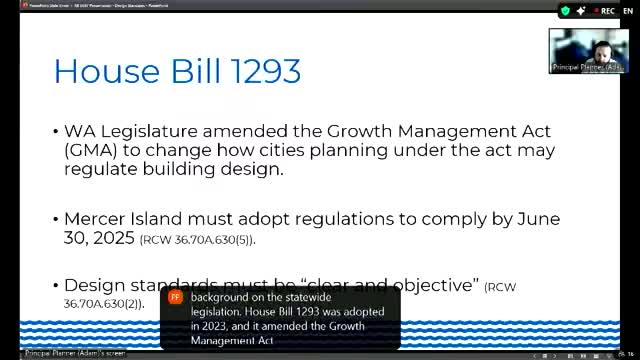
Summary
Mercer Island — The City Council on June 3 voted to direct the city manager to prepare an ordinance that would transfer formal design‑review authority from the volunteer Design Commission to the municipal hearing examiner.
Mercer Island — The City Council on June 3 voted to direct the city manager to prepare an ordinance that would transfer formal design‑review authority from the volunteer Design Commission to the municipal hearing examiner, saying the state’s new requirements make the commission’s discretionary role less applicable.
The action came after staff outlined changes the Legislature enacted in 2023 under House Bill 1293, which requires that local design standards be "clear and objective" and limits public-review steps to a single public meeting. CPD Director Jeff Thomas told the council those changes, and related edits in draft ordinance 25C‑11, remove a pre‑application study session and convert many existing discretionary design criteria into measurable standards.
Why it matters: council members and staff said the new state framework reduces the interpretive role that the volunteer Design Commission historically exercised during design review and suggested that the hearing examiner or the city’s code official would be better suited to issue determinations under objective standards. After discussion, the council voted unanimously to instruct the city manager to return June 17 with an ordinance delegating design‑review decisions to the hearing examiner for council consideration.
Council amendment on affordable-unit comparability: during the meeting councilmembers amended the draft ordinance to clarify how affordable units should compare in size to market‑rate units in the same building. Staff presented two options (require parity or allow a small variance such as 10%), and council favored language tying affordable unit size to parity with the average market‑rate unit for the same bedroom count. The amendment passed on a roll call that the clerk recorded as unanimous.
Authority and process: Thomas and planning staff said the interim ordinance (25C‑11) will become effective on June 30 to meet the state deadline and will remain in effect up to one year while permanent regulations are developed. The bill and the interim ordinance also remove the Design Commission’s pre‑application study session but retain a single pre‑decision public hearing as allowed by state law.
Appeals and public participation: planners noted decisions by the hearing examiner would remain appealable (generally to superior court) and that the hearing examiner process includes a public hearing (with statutory notice periods), while administrative review by the code official typically does not. Several council members said they favored the hearing examiner option to preserve public participation despite the more objective review standard.
Next steps: staff will prepare the ordinance and bring it back for council review June 17; permanent regulations and a work plan for the planning commission’s role in drafting the full code revisions were also discussed.