
Mercer Island council briefed on schematic design and $103.9 million estimate for new public safety and maintenance facility
Get AI-powered insights, summaries, and transcripts
Subscribe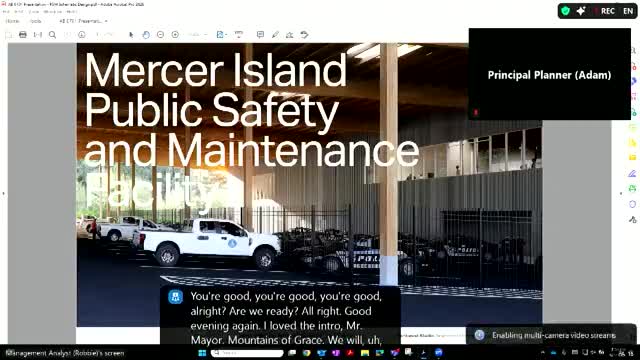
Summary
Council heard a schematic-design update Tuesday showing a two-building complex, covered equipment yards, secured police deployment area and a preliminary project budget of about $103.9 million; staff and architects said the facility is sized to keep emergency operations and critical city services working during disasters.
Mercer Island — The City Council received a detailed schematic-design briefing June 3 on plans for a consolidated public safety and maintenance (PSM) complex and a preliminary project budget the city estimated at about $103.9 million.
The schematic places two primary buildings on the eastern portion of the former City Hall site: a Public Safety & Maintenance Building with public-facing customer service counters, police operations and an emergency operations center (EOC), and an Operations Building with high-bay vehicle and equipment storage, maintenance bays and a materials warehouse. The design groups covered vehicle and equipment storage and creates one-way circulation to reduce vehicle conflicts in the yard.
City Manager Jesse Vaughn and lead architect Aaron Young of Northwest Studio told the council the design is intended to make critical services resilient. Vaughn said the new complex will be a Risk Category 4 structure "designed to remain in operation during events," an attribute the city made a priority for housing police, public works, IT/GIS and the emergency operations function together.
Why it matters: staff and the design team said the current Public Works building and temporary police trailers provide inadequate shelter for personnel and expensive equipment, reduce operational efficiency and contribute to higher maintenance costs. The new design emphasizes covered, semi-heated storage for oversize vehicles, protected loading and unloading areas, consolidated material storage, and secure parking for police vehicles.
Budget and components: the city presented a cost breakdown drawn from a schematic-level estimate and value‑engineering review. Key figures given by staff: - Structures (buildings, weathering covers): roughly $51.6 million (fully loaded) - Site work (utilities, grading, yards): roughly $23.5 million - Project soft costs (design, FF&E, permitting, contingencies): about $21.1 million - State and local sales tax and escalation: roughly $7.5 million - Total project estimate presented: about $103.9 million
Architects and staff emphasized these are early-stage (schematic) numbers. Aaron Young said staff has run a third‑party value engineering review that identified about $2.5 million in potential reductions and tradeoffs; the team has already incorporated several savings items (for example, optimizing glazing systems, rationalizing roof coverage and using prefabricated cold-frame covers for some material bays).
Operational details and programming: the PSM Building’s ground floor is intended to include a public lobby with a customer‑service counter, a records/reception area for police, and a 6,800‑square‑foot EOC sized for roughly 44 people and configurable for training or community use when not activated. The police department program totals about 20,000 square feet on the ground level and includes interview rooms, evidence storage and secure transfer areas inside a gated perimeter. The Operations Building will house a warehouse, vehicle maintenance bays (20‑foot minimum clearances in selected areas) and indoor, semi‑heated storage for oversized fleet vehicles.
Parking and yard counts in the schematic: staff presented parking planning and space counts used for estimating. The design included about 36 secured police vehicle spaces; roughly 86 on‑site fleet/operations spaces (to serve a reported fleet of about 70–71 vehicles); about 112 public/staff parking spaces fronting Southeast 36th Street; and dedicated trailer stalls and oversized vehicle bays. Staff described these numbers as planning assumptions to be refined in later design phases.
What council asked for and next steps: council members asked detailed questions about the amount of enclosed storage needed, the durability and maintainability of the roof and covered structures, locker‑room layouts, how the EOC would function and how the design would preserve the option to add space in the future. Acting Police Chief Michelle Bennett and Public Works Chief of Operations Jason Kittner described daily operational needs that informed the layout (evidence processing, nightly vehicle storage, crew staging for water-main repairs and snow/ice responses). Vaughn and the architectural team said the building footprint and primary site layout are effectively set at schematic design, but interior arrangements and finishes will be refined through design development and construction documents.
No bond or funding decision tonight: council received the briefing and asked for follow‑up details; there was no council vote to adopt a project budget or to place a ballot measure. Staff said they will return with further cost breakdowns, clarified parking and maintenance assumptions, escalation and tax calculations, and potential phasing at future meetings. The team also expects two formal pricing checkpoints as design proceeds: at the mid and final points of design development and construction documents.
Ending: City staff said the schematic and the estimate will be refined over the next months and that they intend to return to council with updates and additional cost and procurement options ahead of any decision to ask voters to approve funding.