Get Full Government Meeting Transcripts, Videos, & Alerts Forever!
Get email alerts on the Hr Staffing Audit topic
No spam. Unsubscribe anytime.
Prince George's County Public Schools audit committee reviews HR staffing audit, pushes tech and contract changes
Summary
At a June 2 Audit Committee meeting, PGCPS human resources chief presented an HR staffing audit that praised recruitment strategy but flagged timeline, position-control and technology problems; the committee heard steps underway including full rollout of the Frontline applicant-tracking system and internal process changes.
Prince George's County Board of Education Audit Committee Chair Dr. Tiffany Anderfold on June 2 heard a human resources audit that identified hiring delays, manual processes and contract provisions as key barriers to filling teacher and staff vacancies across the district’s roughly 20,000 employees.
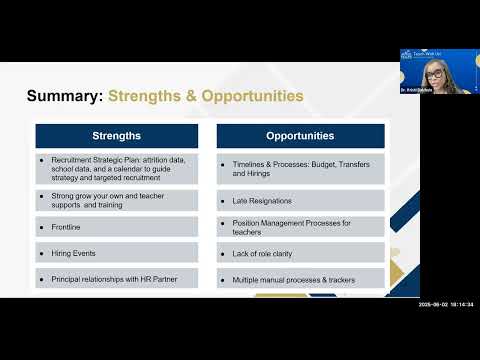
The audit, conducted with support from Urban Schools Human Capital Academy and commissioned by the superintendent, found strengths in the district’s recruitment strategy and grow-your-own programs but recommended changes in collective-bargaining timelines, position-control procedures and information systems to reduce late resignations and speed onboarding.
Dr. Christy Murphy Baldwin, chief of human resources for Prince George's County Public Schools, told the committee the audit focused on the Division of Human Resources’ operations and staffing office and that the district recently moved from Google documents to an applicant-tracking platform called Frontline. “We currently have, close to 20,000 employees,” Baldwin said. “This is the office that's responsible for securing that talent and bringing them in so that we can have employees to do the work within the district.”
The audit highlighted several specific strengths: a documented recruitment strategic plan, investments in Frontline as an applicant-tracking system, large “grow-your-own” pipelines including paraprofessional and substitute programs, and participation in the Maryland LEADS program (Baldwin said about 21 participants are completing teaching degrees this year).
Committee members and staff discussed major operational constraints the audit identified. Baldwin said the district’s student-based budget timing means staffing files often are not finalized until early July; that delay, combined with Maryland rules allowing teachers to resign up through July 15, contributes to late resignations and hiring losses. “We do not get our staffing file until around the first week in July,” Baldwin said, noting many May graduates secure other positions before the district can issue offers tied to specific schools.
The report also flagged the district’s use of “true position control,” which ties every employee to a specific costing string and can block hiring to fill longer-term leaves. Baldwin said that practice protects budget integrity but complicates rapid replacement when employees are on extended leave. The audit recommended clarifying which functions belong to HR versus benefits, payroll or risk management to reduce misdirected inquiries and free HR staff to support principals.
Recommendations discussed at the meeting fell into three buckets: contract changes, process and IT changes, and staffing-office improvements. On contracts, the audit suggested shortening the teacher voluntary transfer window (currently January 15 to about March 15–16 under the teacher contract) and reconsidering the timing for involuntary placements so new hires are not automatically displaced by surplus placements. Baldwin said contract language controls those timelines and that changes would require negotiation with employee representatives.
On technology and process, the audit urged more automation and tighter integration between Frontline and the district’s Oracle system. Baldwin said Frontline was piloted with about 10 principals last year and is now in full implementation for instructional hiring; Frontline feeds Oracle but the interface can be delayed (she described about a 24-hour feed time). She said some central-office and administrative staffing still use manual processes.
Board members raised candidate-experience concerns. District 5 Board Member Robin Brown recounted a personal application experience and said antiquated systems had harmed candidate engagement: “I still haven't heard from PGCPS,” Brown said, describing a prior application that yielded no timely response. Baldwin said the district is shifting focus from mere “service” to a candidate “experience” and has begun requiring clearer process maps, standard forms and more direct email routing.
Several short-term and completed steps were reported: the HR office will be renamed Talent Acquisition and Management effective July 1; a principal advisory board and a selection-and-hiring guidebook have been completed; HR partners meet principals twice yearly and the audit recommended adding instructional directors to those meetings. The committee also heard that district leaders considered posting vacancies by specific schools but expressed concern about optics because some schools have far more openings than others.
No formal motions or votes were taken at the audit-committee meeting. Several board members requested follow-up reporting: Baldwin and committee members discussed returning in approximately one year to review Frontline’s full-year outcomes for candidate experience, onboarding timeliness and any measurable reductions in vacancy timelines.
The committee also discussed pursuing external help to capture exit-interview data if the FY26 budget provides funding; Baldwin said an outside vendor could help quantify why candidates and early-career teachers leave. Baldwin closed by inviting board members to visit job fairs and said she would arrange future updates as budget timelines and system changes progress.