Get Full Government Meeting Transcripts, Videos, & Alerts Forever!
Get email alerts on the Fair Budget topic
No spam. Unsubscribe anytime.
Bonner County reviews fairgrounds budget, seeks funds for hydrants, bleachers and fair book
Summary
At a Bonner County budget workshop, Fair Manager Mark Knapp outlined requests to fund ongoing fairgrounds repairs and projects — including a $40,000 fair‑expenses line, about $20,000 to replace four nonfunctional fire hydrants, and rollover authority for unfinished work — while commissioners asked for clearer accounting and follow‑up analysis.
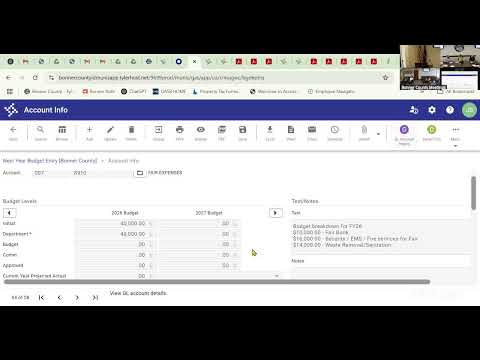
Bonner County commissioners met with Fair Manager Mark Knapp at a budget workshop to review the fairgrounds operating and capital needs, including a request to maintain a $40,000 fair‑expenses line (account 89‑10), a separate $20,000 capital request to replace four damaged fire hydrants (request entered to line 93‑80), and rollover authority for unfinished FY25 projects.
Mark Knapp, Fair Manager, told commissioners, “Our budget focuses as well only on our A and D budget, for personnel salaries and benefits and our B budget, which has, historically been used for supplies, repairs, and maintenance.” He laid out recent work — bleacher removal and reconstruction, lighting upgrades, insulation of a shop, and repairs to swine wash racks — and asked that unused project funds be allowed to roll into the next fiscal year so the work can be completed.
The workshop centered on three near‑term financing items. Knapp said the county’s 89‑10 line, historically used for “fair expenses,” was increased from $20,000 to $40,000 in FY25; commissioners asked staff to confirm whether that increase had been recorded as a recurring base increase in prior minutes or if it was treated only as an annual allocation. Knapp asked that any FY25 project dollars that remain unspent be moved forward to finish lighting, arena seating/bleachers and electrical work.
Knapp also requested a $20,000 allocation in capital line 93‑80 to replace four fire hydrants he described as “completely defunct” or unable to be repaired at their current locations. He said Consolidated Supply quoted $16,253 for materials and that renting a mini‑excavator could add roughly $2,000–$3,000 to the total. Commissioners and staff asked whether it would be preferable to investigate moving the hydrants to the city side of the meter so the city would assume long‑term ownership, and directed Knapp to report back on whether all four hydrants are required for proper coverage or whether fewer replacements would suffice.
Commissioners also pressed for clearer itemization of costs and stronger documentation of what the fair’s county funds pay for. Knapp said the $40,000 breakdown he used for planning includes production and printing of the fair book (he estimates $10,000 for printing and production next year, down from a prior $13,000 estimate after a one‑time file redesign), security/EMS/fire standby (~$16,000), and sanitation (he listed $25,000 as the sanitation line). He said revenue from sponsorships and advertising flows into the enterprise fund and is not applied against the tax levy line, complicating how levy dollars are perceived by members of the public.
On capital projects, Knapp said work to replace bleacher pads and install new bleachers was budgeted at about $130,000 with an additional $40,000 for miscellaneous repairs; he told commissioners that about $114,000 of that allocation has been spent to date. He asked for the ability to roll unspent funds into FY26 to finish projects that are delayed due to external processes such as utility‑company rebates for lighting work.
Commissioners asked several follow‑up items and gave direction rather than taking formal votes: staff should (1) confirm the accounting status of the prior increase to the 89‑10 fair expenses line, (2) provide an itemized list of projects and the precise amounts that would need to roll into FY26, (3) analyze whether all four hydrants must be replaced or whether a partial solution is possible, and (4) evaluate the feasibility and cost‑benefit of reconfiguring hydrants so they would be on the city side of the meter and thereby potentially be maintained by the city.
“Mark, you’re in a uniquely challenging position,” Chair Powell told Knapp during the meeting; commissioners repeatedly noted that the fair board makes some spending decisions independently and that those enterprise choices — including whether to run finances through the county’s Munis system — affect transparency and the county’s ability to track levy‑funded expenditures.
No formal motions or votes were recorded during the workshop segment. Commissioners asked for follow‑up information and a subsequent conversation once staff returns with confirmations and written itemizations of outstanding costs and project status.