
Miami Beach committee approves consolidated financial policy; orders deeper review of salary spending and hiring practices
Get AI-powered insights, summaries, and transcripts
Subscribe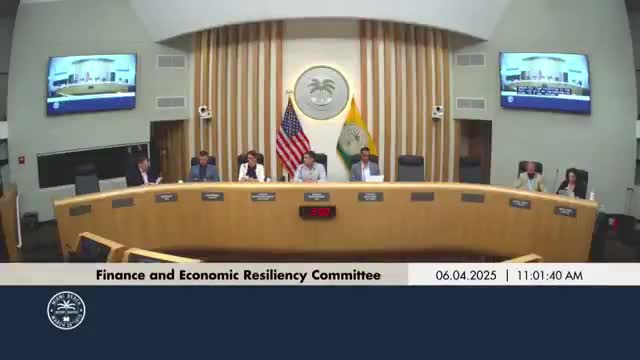
Summary
The Finance and Economic Resiliency Committee approved a consolidated citywide financial policy and directed staff to pursue additional fiscal-responsibility measures including a study of salary-and-benefit share of the general fund, possible hiring restrictions and approaches to steering surpluses toward capital needs.
The City of Miami Beach Finance and Economic Resiliency Committee on June 4 approved a consolidated set of citywide financial policies and directed staff to pursue additional fiscal-responsibility measures, including a benchmarking study of payroll costs and options for hiring controls.
Committee members said the update is intended to gather decades of resolutions into a single accessible policy and to give officials clearer guardrails for reserves, capital funding and handling of one-time revenues. The committee also asked staff to refer a motion to the Budget Advisory Committee for more detailed analysis of salary-and-benefit levels and to return with recommendations for July's budget workshop.
Committee chair Commissioner Suarez said the consolidated document bundles some 14 resolutions the administration located during its review and preserves existing reserve rules, noting the city’s standing policy aims for three months of general-fund reserves (two-month emergency reserve plus one month contingency). “We’re going to be finding ourselves in a situation where we have a lot more places where we want or desire to spend money than our ability to do so,” Suarez said.
City Chief Financial Officer Jason (CFO) described several specific provisions in the consolidated “Comprehensive Financial Policies” draft: retention of the existing reserve structure, formalization of a policy to set aside portions of one-time lump-sum payments, a capital funding goal equal to 5% of annual operating revenues, and an incremental plan to devote a larger share of general-fund interest income to capital (25% in the current year, rising by 5 percentage points annually). He also proposed a debt-management policy with standard refunding guidance.
The committee spent substantial time on the city’s payroll burden. Commissioners raised the share of the general-fund budget dedicated to salaries and benefits — described during the meeting as 71% — and asked for staff to prepare comparative benchmarking across peer municipalities and an analysis that separates public-safety compensation from other salary costs. Commissioner Rosengonzales urged a target to reduce the share toward 65% as an “aspirational” goal; others urged caution and asked the administration to show tradeoffs and implementation paths.
City Manager Eric Carpenter said the administration supports the direction and committed to returning with an implementation outline for the committee, including how department leaders will be asked to prioritize during storms and other emergent events. CFO Jason said the commission’s additional direction — to refer the consolidated policy and a pay-and-benefit percentage analysis to the Budget Advisory Committee — will kick off the technical work.
The committee approved the consolidated financial policy with a recommendation that it be referred to the full commission and the Budget Advisory Committee for further review and potential referral back to the committee as part of the FY26 budget process. The administration will present the requested benchmarking and a hiring-control proposal for discussion in the budget cycle.