Get Full Government Meeting Transcripts, Videos, & Alerts Forever!
Get email alerts on the City Budget Water Sewer topic
No spam. Unsubscribe anytime.
Hickory Council adopts $159 million budget, backs water-system investments and small rate, tax changes
Summary
On June 3, 2025, the Hickory City Council approved a $159 million recommended fiscal 2025–26 budget that includes measures to speed investments in water and sewer system resiliency, a proposal to dedicate a half-cent property tax increase to water infrastructure, and modest utility rate adjustments.
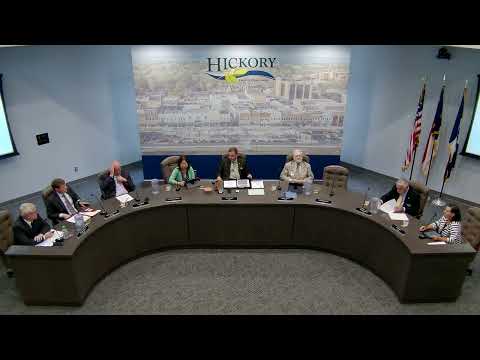
The Hickory City Council on June 3 approved the city manager's recommended fiscal 2025–26 budget, a $159,000,000 spending plan that city staff said accelerates investments to build redundancy and resiliency in the city’s water and sewer system.
City Manager Warren Wood presented the recommended budget and told the council the proposal would ‘‘set us on with our water and sewer system and serving the generations in the future’’ if approved. The full package passed unanimously after a public hearing with no speakers.
The recommended budget increases total spending roughly 10% over the current year on paper, with operating funds rising about 6%. City staff emphasized three core funds represent about 80% of activity: the general fund ($78.8 million recommended), the water and sewer fund ($41.7 million recommended) and the solid waste fund. Wood told the council the presentation focuses on those three funds because of their scale and near-term needs.
To raise money for water projects, staff recommended raising the property tax rate by a half cent (from 45.5¢ to 46¢ as stated in the presentation) to generate roughly $425,000 annually that would be restricted to the water and sewer fund. Wood also recommended modest utility rate changes: a 1% increase in the customer charge, a 1% increase in the availability charge, and a 5% increase in the volume charge for water and wastewater. City staff estimated the net effect on an average household (5,000 gallons per month) would be about $1.51 per month, keeping the typical bill below the regional average.
Wood told the council recent storm impacts (Hurricane Helene) and historic vulnerabilities moved the city to accelerate several projects. Near-term and funded projects cited by staff include a $13,000,000 automated meter infrastructure (AMI) program to replace meters systemwide; a $4,000,000 raw-water intake electrical and intake-improvement project (under design and eligible for FEMA repair after storm damage); and the biosolids facility, described as the largest capital project to date and expected to go live in months. City staff also reported the city paid for purchase and conversion work on the former Longview water treatment plant to add about 1,300,000 gallons of storage, with related work under design as part of ongoing capital efforts.
Unfunded or longer-term needs described in the presentation include a second raw-water intake (estimated $25,000,000, five-year goal), projects to improve regional connectivity with neighboring jurisdictions, a flow-diversion project to relieve the Moose Club pump station (estimated $10,000,000), and planning for a potential new 5 million gallon-per-day water treatment plant (expandable to 10 million) as a 15-year, system-scale option. Wood said an illustrative, long-range package of water projects could total roughly $270,000,000 but stressed that number is a long-term planning estimate rather than a next-year request.
Staff also told the council two pump-station flooding mitigation projects (Snow Creek and Falling Creek) had designs funded but that anticipated FEMA construction funding did not materialize; the two projects combined represent roughly $13,000,000 of construction the city is seeking to cover through alternative grants and loans. Wood discussed financing options including system development fees (statutorily required to be reserved for capacity-related projects), state revolving loan funds (SRF) administered by North Carolina (a low-interest loan program staff noted as competitive and desirable), grants, and bond options.
Wood said the city operates a geographically large regional system — serving about 20,000 customers across 12 jurisdictions — and that existing contracts and sold capacity to nearby towns must factor into planning. He also told the council the city bid the Microsoft line expansion (a project that would loop the south side water network and support economic development) and was evaluating vendor proposals.
On the solid-waste side, staff recommended a $8.3 million budget (about 6.4% increase) and a $1-per-month increase in the residential user fee (as described in the presentation) to help cover rising costs; staff said the fund is operationally self-supporting for personnel and operations but that capital costs are typically funded from the general fund.
After presentation and questions, the council held a public hearing (no speakers), then moved to adopt the recommended budget. The motion to approve carried unanimously.
City staff said the recommended budget document is publicly available online and at the library and that staff would continue evaluating capital procurement and financing options, including SRF applications and grant opportunities discussed in the presentation.