Citizen Portal

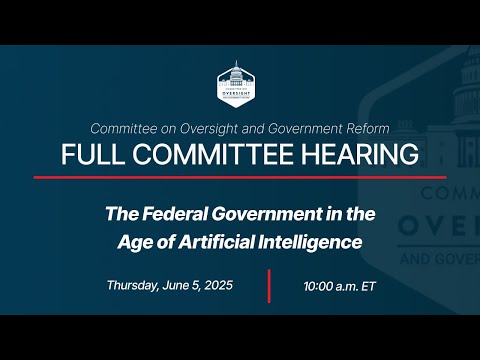
Experts at House hearing urge faster AI adoption, procurement fixes and stronger cybersecurity safeguards

3682732 · June 5, 2025

Get AI-powered insights, summaries, and transcripts

Subscribe
AI-Generated Content: All content on this page was generated by AI to highlight key points from the meeting. For complete details and context, we recommend watching the full video. so we can fix them.

Summary

Industry and oversight experts told the House Oversight Committee that AI can boost federal productivity and fraud detection but warned that procurement barriers, legacy IT and lax data controls — including reports of private contractors accessing federal data — threaten security and effectiveness.

WASHINGTON — Witnesses at a House Oversight and Reform hearing on artificial intelligence on Wednesday urged lawmakers to accelerate government adoption of AI to boost productivity and detect fraud, while warning that procurement hurdles, outdated IT systems and weak data controls risk undermining those benefits.

Panelists included Yil Ili Barakhtari, president of the Special Competitive Studies Project; Bhavan Shah, founder and CEO of Moveworks; Linda Miller, founder of TriClad and former Pandemic Response Accountability Committee deputy executive director; Adam Thier, senior research fellow at R Street Institute; and Bruce Schneier, a cybersecurity expert at Harvard Kennedy School.

Why it matters: Witnesses told the committee that AI offers measurable benefits — from streamlining paperwork and freeing employee time to detecting improper payments more quickly — but that the federal government—s current acquisition rules, fragmented data and security lapses prevent agencies from realizing those gains. Several witnesses also raised national security and privacy concerns after recent reports that private contractors and contractors— affiliates accessed or processed large federal datasets.

What the witnesses said

- Yil Ili Barakhtari said the strategic competition with China centers not only on model development but on deployment and infrastructure. He called for a national strategy, expanded AI R&D funding and reforms to attract global talent.

- Bhavan Shah described Moveworks— work automating employee support and said private-sector pilots show substantial efficiency gains. Shah said FedRAMP and multi-year contracting favor incumbents and that Moveworks spent more than $8.5 million and over three years to reach FedRAMP readiness, a cost he said is prohibitive for smaller innovators.

- Linda Miller identified data quality and siloed systems as major obstacles and advocated for regulatory sandboxes and proof-of-concept programs to let agencies test AI pilot projects under controlled conditions. Miller said privacy laws written decades ago do not match modern needs and that anonymization and advanced privacy techniques are necessary when handling sensitive data.

- Adam Thier emphasized that broad-based productivity benefits are possible if agencies modernize procurement, improve technical literacy and protect a competitive market for AI products. He cautioned that an expanding patchwork of state and local AI rules could raise costs and complicate federal deployments.

- Bruce Schneier warned of grave cybersecurity risks from aggregating federal data and from private actors processing that data without strong controls. Schneier said the combination of sloppy security practices and centralized datasets "represents a massive increase in government power and, therefore, a security threat," and urged assuming that copies of exfiltrated data now exist outside government control.

Procurement, FedRAMP costs and pilots

Several witnesses urged immediate steps to streamline procurement for AI tools, including expanding pilot programs and reducing the burdensome time and cost to get FedRAMP certification. Shah told the committee Moveworks— FedRAMP effort consumed years and millions of dollars and recommended more government incubators and developer programs to lower barriers for startups.

Use cases: fraud detection and administrative efficiency

Panelists said AI is already useful for detecting improper payments, mining claims data for anomalies and automating routine tasks such as FOIA processing, benefits reviews and help-desk requests. Miller cited a high return-on-investment example for continuing disability reviews and urged piloting AI agents in high-value processes.

Workforce and training

Witnesses and members agreed that the federal workforce must be part of any rollout. Speakers urged training programs and literacy campaigns; the committee—s chair mentioned an "AI Training Extension Act" intended to expand federal AI skills for employees.

Security and data governance

Schneier and other witnesses repeatedly flagged the risk of centralizing government data and feeding it into private AI systems. Schneier told lawmakers to "assume that our adversaries have copies of all the data Doge has exfiltrated" and warned such data could be used for coercion or to undermine national security.

What lawmakers asked

Members pressed witnesses on whether AI could replace federal workers, with several witnesses saying AI should augment rather than replace public servants. Lawmakers also raised specific policy options: expanding acquisition thresholds, creating agency innovator programs and launching national infrastructure investments to power compute-intensive AI.

Bottom line

Witnesses joined across sectors in urging faster, but deliberate, AI adoption: speed up procurement reforms, invest in infrastructure and training, pilot controlled deployments, and strengthen cybersecurity and privacy safeguards to prevent misuse of aggregated federal data.

The hearing record shows strong convergence on the technology—s potential and the policy steps needed to capture it while managing risk.