
Volusia committee asks staff to draft countywide floodplain rules, weigh compensatory-storage standards and 2-foot freeboard in high-risk areas
Get AI-powered insights, summaries, and transcripts
Subscribe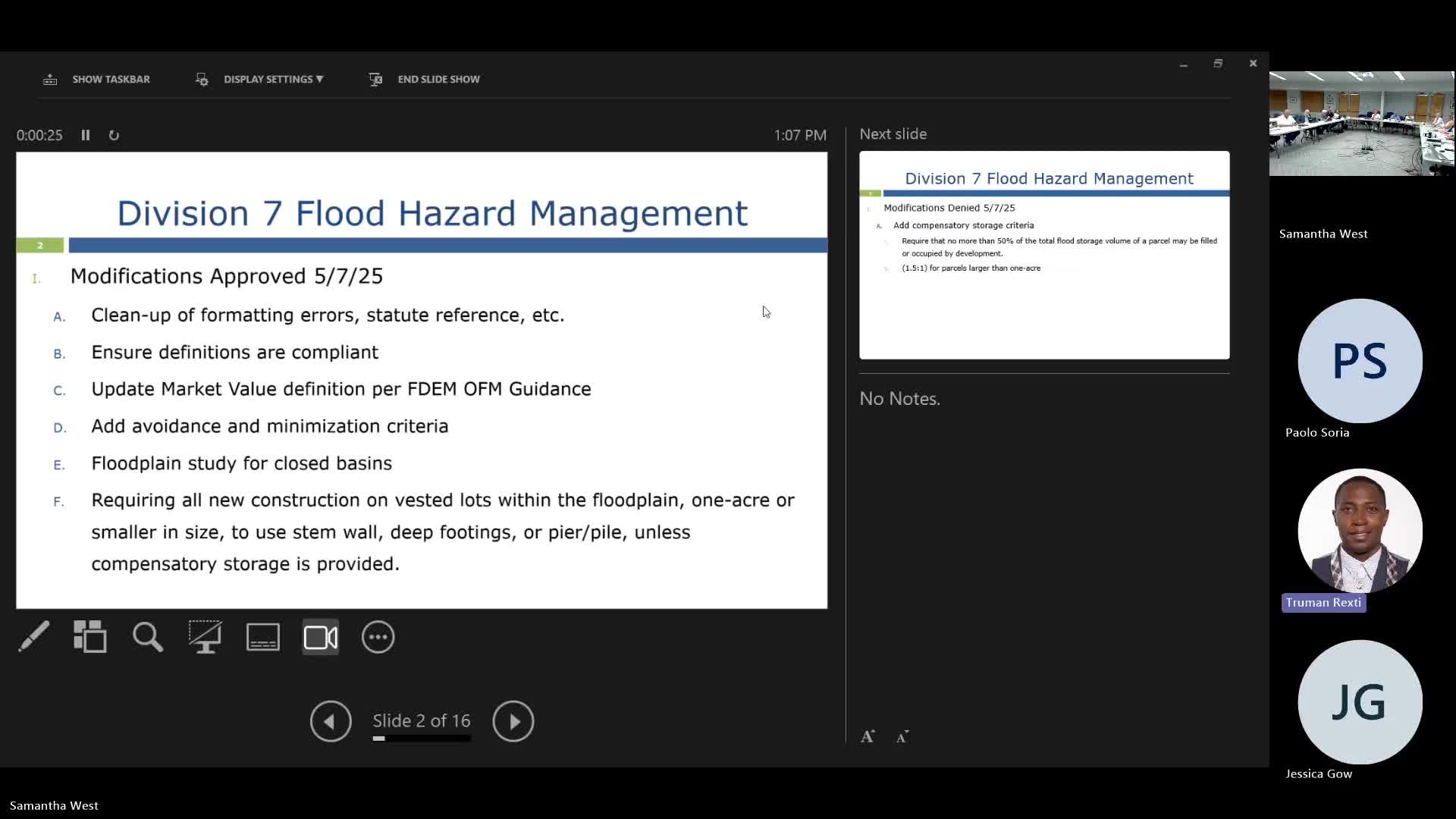
Summary
Volusia County’s Environmental and Natural Resources Advisory Committee on June 4 asked county staff to draft a countywide floodplain-management chapter and to bring back options for a minimum compensatory-storage standard and criteria for deviations.
Volusia County’s Environmental and Natural Resources Advisory Committee on June 4 asked county staff to draft a countywide floodplain-management chapter and to bring back options for a minimum compensatory-storage standard and criteria for deviations.
The committee voted to ask staff to prepare proposed chapter 50 language requiring floodplain mitigation standards, to evaluate a compensatory-storage threshold “above 1 to 1,” and to craft variance/appeal criteria and engineering review guidelines. Members also voted separately to direct staff to make chapter 72 consistent with the chapter 50 minimums. Later in the meeting the committee unanimously endorsed asking staff to “consider a higher standard of 2 feet” of freeboard for selected high-risk areas and to return with maps showing the geographic scope.
Why it matters: county rules on compensatory storage and flood-elevation standards determine how new development is allowed to displace floodplain volume. The committee’s actions will shape minimum countywide requirements that affect developers, engineers and homeowners and will influence Volusia’s standing in FEMA’s Community Rating System (CRS).
Committee members and staff debated how to balance a straightforward volume-based rule against site-specific engineering solutions. Ben Bartlett, staff member, framed the issue: “protecting the floodplain is one of the most important things you can do to ensure that new development doesn't cause flooding or impacts off‑site,” and favored a safety factor though he said the precise percentage is uncertain. Several members said New Smyrna Beach’s 50 percent compensatory standard informed the conversation but does not by itself justify countywide adoption. As one committee member said, “I didn't like the idea of 50% more flood volume” because that could rule out other mitigation tools; others argued a higher standard provides protection during unusual storms.
Staff and members discussed the following technical and policy points: - Current practice and law: the county follows federal floodplain management requirements (NFIP/FEMA) in practice, but the committee heard that Volusia’s code contains no explicit countywide compensatory-storage mandate; the proposal is to codify a minimum standard in chapter 50 and align chapter 72 with it. - CRS and compensatory-storage: participants noted New Smyrna Beach’s code requires up to 50% additional compensatory storage and that a 1.5:1 ratio can yield CRS credits, but speakers said the connection between a 50% rule and CRS scoring is not fully dispositive. - Engineering alternatives and tailwater conditions: staff and engineers warned that simple cup‑for‑cup volume swaps can be inappropriate in areas with positive outfalls, tidal influence, or variable tailwater conditions; engineers said carefully scoped basin studies or FEMA technical procedures may better address many sites. - Variance/appeals process: staff pointed to the existing appeals/variance authority in Section 72‑748 of the land‑development regulations as the mechanism to evaluate site-specific engineering demonstrations when applicants request deviations from the presumptive compensatory standard.
Direction and next steps: the committee’s motion—moved during the meeting and read into the minutes by staff—directed staff to draft language for chapter 50 that would (a) establish countywide minimum floodplain mitigation standards, including compensatory storage as a defined item, (b) examine an appropriate factor of safety above 1:1 and (c) propose criteria for deviations and appeals, and to prepare draft chapter‑72 edits for consistency. The committee also asked staff to prepare maps and analysis to identify which areas should be subject to a 2‑foot freeboard standard and to return with draft ordinance text for a future meeting.
What the vote did and did not do: the committee did not adopt a numeric countywide compensatory-storage ratio at this meeting; it directed staff to prepare draft ordinance language and analysis. The committee likewise did not finalize which places would get a mandatory 2‑foot freeboard — staff was asked to return with maps and proposed boundaries.
Background and constraints: the committee discussed state and federal overlays that affect local authority. Staff and the committee cited FEMA, the NFIP and the CRS program as incentives driving higher standards; they also discussed pending or recent state legislation that could limit local regulatory authority (SB 180 and the Live Local Act provisions discussed in the meeting). Staff cautioned that where state law creates a preemption or other limits, the county’s ability to adopt more restrictive rules could be constrained.
End note: staff will return with draft chapter 50 text, a consistent chapter 72 amendment package, mapping of areas for a potential 2‑foot freeboard, and proposed deviation/variance criteria for committee review.