Get Full Government Meeting Transcripts, Videos, & Alerts Forever!
Get email alerts on the Arts Culture topic
No spam. Unsubscribe anytime.
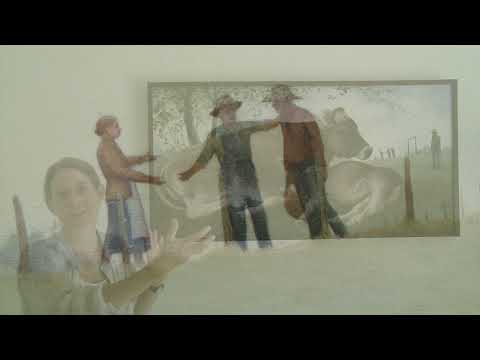
Missoula artist Stephanie Frostet describes painting 'Return of the Prodigal Son' and her narrative approach
Summary
Artist Stephanie Frostet of Missoula explained the themes and techniques behind her painting "Return of the Prodigal Son," emphasizing the rarely depicted "dutiful son," rural imagery and her use of photographic references and modeling.
Stephanie Frostet, an artist living and working in Missoula, described her painting "Return of the Prodigal Son" and her approach to narrative painting; the transcript does not specify when she spoke.
Frostet said she chose to focus on the story's "dutiful son," a figure she described as "more interior" and harder to portray than the prodigal, and placed that character in a rural setting to explore cultural metaphors rooted in agriculture.
"The prodigal son was an easy villain for me," Frostet said. "I wanted to give some space to the dutiful son... his journey is more interior. He has to reconcile with his brother somehow." She said many historical images show the prodigal's debauchery and return, but not the dutiful son.
Frostet told the meeting that she framed the relationship between the brothers in the painting using elements of the rural landscape: a gate, cattle and a farm entry that, she said, help to "frame the gulf between them." She described the cattle and the setting as evoking "nurturance and abundance," while also implying other consequences for the creatures and the land.
She described her studio practice and sources: she trained early in Baltimore at the Maryland Institute, grew up in a rural area in Walla Walla, Washington, and often combines photographic references, anatomy books and posed models. "These cows were photographed at the Western Montana Fair," she said. She added that she modeled for the three principal characters and combines photographic and artistic sources in a composite process.
Frostet said her aim is not to tell a complete story but to "set it in motion" so viewers supply what happened before and what might come next. She described a preference for subtle color and formal arcs over flashier visual devices. "One of my choices was to try not to be original, trusting that what interests me... will come out in an authentic way that is unique to me and relevant to my time," she said.
Less technical details from Frostet's remarks included her use of small studies for parts of a composition and the iterative posing and photographic research she conducts while working on larger canvases.
The transcript provides no formal actions, votes or external decisions tied to the presentation.