Get Full Government Meeting Transcripts, Videos, & Alerts Forever!
Get email alerts on the Art Exhibition topic
No spam. Unsubscribe anytime.
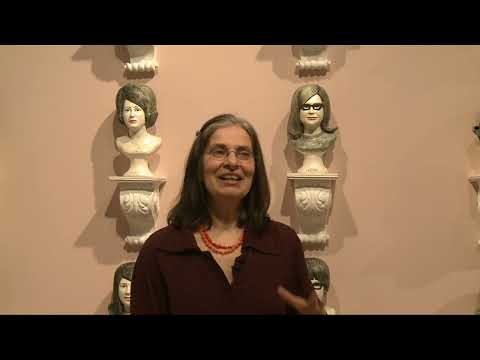
Marilyn Lizzo displays 63 ceramic portraits in "Good Girls 1968" at Missoula Museum of Art
Summary
Artist Marilyn Lizzo described her exhibit "Good Girls 1968," a series of 63 ceramic head portraits made from 1968 yearbook photos, and discussed her process, materials and the class reconnections the project produced.
Marilyn Lizzo, an artist from Moscow, Idaho, spoke at the Missoula Museum of Art about her exhibition "Good Girls 1968," a display of 63 ceramic portrait heads derived from her 1968 high school yearbook photos.
Lizzo said she began the series by working through the yearbook alphabetically, using small 2-by-2-inch photographs as the basis for three-dimensional sculptures. "I started with the a's in the yearbook, and then I worked, my way through, the yearbook to do the 63 heads," she said, describing both the starting point and the scope of the project.
The exhibition, Lizzo said, is intended to highlight the opportunities and expectations faced by young women in 1968. "I wanted to do the girls to honor them because back in 1968, there wasn't the opportunities that the the guys had," she said. Lizzo described how the portraits capture period details — bouffant hairstyles, heavy black plastic glasses and the fashions of the era — while also pairing the youthful images with later-life updates when available.
Lizzo described her process in detail. She made a generic head model, produced a plaster mold, and pressed low-fire white body clay into the mold; she then individualized each piece by sculpting hair, facial features and clothing details from the yearbook photos. She used ceramic stains as colorants and applied a small amount of glossy glaze to lips and the whites of the eyes. For display she mounted the sculptures on matching plaster corbels that she sourced from a maker in Mexico; she said she ordered more than 80 corbels to house the works.
The project also became a prompt for reconnecting with classmates. Lizzo said she began the work in February 2003 and later traveled to a class reunion in Sharon, Pennsylvania, where "we had about a a 60 some people show up for the reunion." She said she eventually located about 50 classmates who sent updated photos and information that became part of the exhibition context.
Lizzo recounted finding a longtime friend, Mary Reynolds, after tracking down contact information and speaking by phone; Reynolds had been in the band while Lizzo had been a majorette. She noted the visual differences between siblings she portrayed, citing Mary and her twin sister Nora Reynolds as examples of how individual style diverged even within the same yearbook page.
On the museum installation, Lizzo praised the Missoula Museum of Art's presentation and the gallery architecture. "The museum did an absolutely amazing job of putting these up," she said, adding that the light-pink background and the building's columns enhanced how the heads read as a group. The artist said the exhibit invites viewers to see both the physical likenesses from youth and the later-life narratives revealed through updates and reunion conversations.
The presentation focused on the artwork's conception, technical approach and the social context of 1968 as reflected in the portraits. No formal actions or votes were recorded during the event.