
Pinellas BOAA denies request to convert former daycare into 13-unit multifamily development in Seminole
Get AI-powered insights, summaries, and transcripts
Subscribe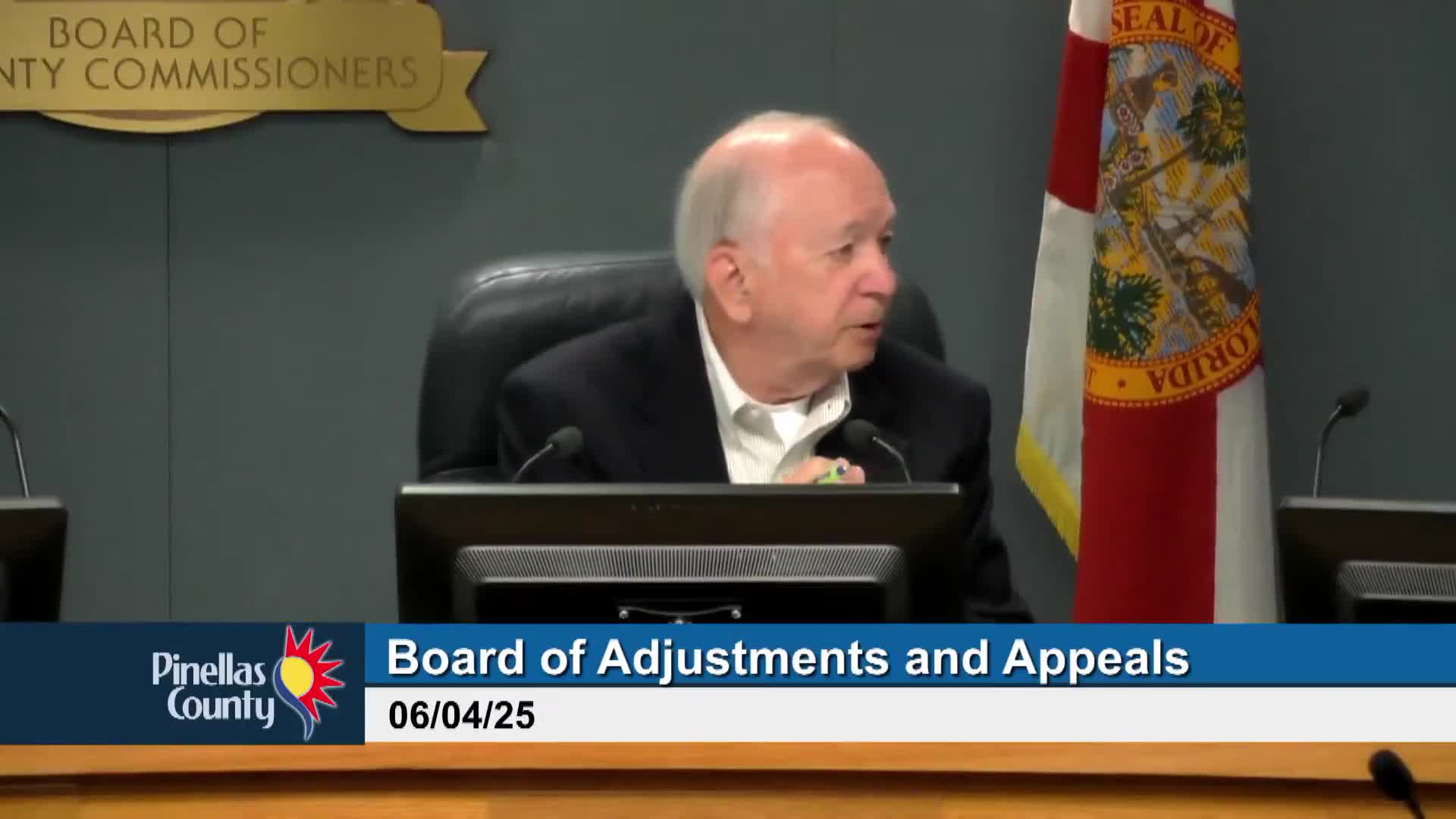
Summary
The Pinellas County Board of Adjustment and Appeals voted 4-1, with one recusal, June 4 to deny without prejudice a Type 2 use application to convert a former daycare on First Street North into a 13-unit multifamily property that the applicant said is intended for short-term rentals.
The Pinellas County Board of Adjustment and Appeals on June 4 denied without prejudice an application to allow a 13-unit multifamily conversion of an existing one-story former daycare building on First Street North in unincorporated Seminole, the board said, by a 4-1 vote with one member recused.
Board members and nearby business owners said the project, proposed by JRFF LLC, raised unresolved utility-easement, parking and compatibility questions and appeared aimed at short-term rental occupancy. Staff had recommended conditional approval of the Type 2 use, which would permit multifamily development in the C-1 neighborhood commercial zoning district if the board granted the exception.
The board’s vote matters because a Type 2 use is required to allow multifamily housing in the county’s C-1 zone; approval would have let the applicant pursue site-plan review and permitting required to make changes, including any utility hookups or fire-protection upgrades.
Molly Cord, principal planner with Pinellas County Building and Development Review Services, told the board the subject property is roughly 0.66 acre and contains a 7,296-square-foot, one-story structure built in 1981. The county’s future land-use designation for the parcel is Commercial General, which allows a residential density up to 24 units per acre—about 16 units on a 0.66-acre lot—so the proposed 13 units fit the comprehensive-plan density limit but still require the Type 2 approval and later site-plan review. "Staff is recommending conditional approval," Cord said during her presentation.
Jordan Hidalgo, appearing for JRFF LLC, acknowledged the applicant intends the units to be short-term rentals and said the development path would first require the multifamily approval before any separate administrative approvals for short-term rental operations. "The end goal is for these to end up as Airbnbs," Hidalgo said. He added that the project would consist mainly of one- and two-bedroom units and that the applicant submitted preliminary architectural drawings and had begun permitting steps.
Multiple nearby business owners and residents testified in opposition. Jody Whitcomb, president of Jodo Inc., which operates Jodo's restaurant adjacent to the site, said she and other proprietors are "not comfortable supporting this change," citing concerns that there is no valid easement to access a water line or fire hydrant located on neighboring property and that construction would disrupt employee and customer parking. Whitcomb asked the board to deny the application without prejudice.
Other objectors raised similar technical concerns about utilities and site access. Mike Lohrey, whose family owns the parcel immediately west of the site and leases to a children’s dance studio, said he was "very concerned" about possible registered-offender occupancy in transient housing and questioned how the project would connect to the public sewer system, saying he found no recorded sewer easement. Several speakers pointed to alleged errors in the applicant’s concept drawings that, they said, mislocated utilities and showed a proposed dumpster on an adjacent property.
Speakers and the applicant also debated terminology and scope. County staff and the county attorney clarified that the board’s decision was limited to whether a multifamily use (a Type 2 use) is allowed in this C-1 parcel; details such as exact utility hookups, parking, location of dumpsters and technical compliance with fire and building codes would be handled at later administrative site-plan and permitting stages. Assistant County Attorney Maria White reminded the board that quasi-judicial hearings require "competent, substantial, fact-based testimony or evidence" to be considered.
Board discussion referenced neighborhood compatibility more than the technical details that objectors raised. Board member Hunsicker moved to deny the Type 2 use "based on the fact of a multifamily, proposed 13 short term rental unit, multifamily unit, as it does not ... [meet] compatibility for the area, adjacent neighborhoods and surrounding businesses." The motion to deny, made by Hunsicker and seconded by Bello, carried 4-1 with one recusal; the transcript records the outcome as "passes, with 4 to 1 with Mr. Warner recusing." The hearing record notes the denial was "without prejudice," meaning the applicant may address concerns and reapply.
During public comment, several speakers also raised the applicant’s asserted civil and criminal history. Board members treated those claims as background testimony and did not attach them to the formal findings; the board’s stated reason for denial centered on compatibility, not on allegations about the applicant’s prior legal matters.
County staff clarified two procedural points: if the board had approved the Type 2 use and the applicant failed to develop the project, the Type 2 approval would expire after two years; and the Florida Building Code and the plans-review process ultimately determine how many occupants are allowed per unit.
The board closed the hearing after voting and approved its previous meeting minutes. The June 4 denial terminates the application for now; the applicant may revise plans and pursue administrative site-plan review only if and when the board approves a future Type 2 use or the applicant obtains other necessary approvals.