Get Full Government Meeting Transcripts, Videos, & Alerts Forever!
Get email alerts on the Zoning topic
No spam. Unsubscribe anytime.
Coconino County hearing officer imposes fines after recall hearing in Bacon zoning case
Summary
A Coconino County hearing officer found Walter and Dana Bacon remain in violation of the county zoning ordinance and said penalties set in an earlier order will be imposed; the county and the respondent discussed possible payment arrangements and compliance steps.
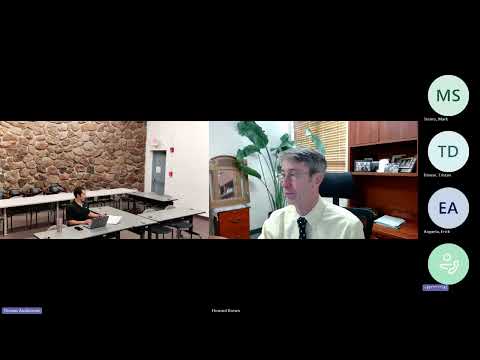
A Coconino County hearing officer on May 20, 2025, determined the Bacon property remained out of compliance with the county zoning ordinance and said penalties set in an April 7 order will be imposed.
The recall hearing in County of Coconino v. Walter and Dana Bacon considered whether the respondents had cured violations described in citation PCC 20 2-Dash-0 0 4 0 after being given until May 7, 2025, to come into compliance. County witnesses presented follow-up site-visit photos and reports showing the same inoperable vehicles, secondhand materials and fencing previously documented by the county; Walter Bacon testified by phone that he and his wife had been unable to address the property because they were temporarily living in a homeless shelter and ill.
County representative Mr. Stento introduced exhibits, including the April 7 order the hearing officer issued after the initial hearing and photographic evidence the county labeled R-2 through R-5 from May site visits. Stento testified the May visits showed "the same state of the vehicles" documented in February and March 2025 and asked the hearing officer to admit the May exhibits into evidence; the exhibits were admitted. Compliance manager Mark Cento and code enforcement officer Tristan Doss were identified as the staff who made follow-up visits on May 5 and May 20 (with an additional visit noted on May 29).
Walter Bacon, the respondent, testified by phone and said, "I've been in a homeless shelter right now, unable to drive myself, and my wife is sick." He said he was arranging people who could fix flat tires, obtain keys and remove scrap items and asked that penalty payments be held until he could address the property. The county witness responded that satellite imagery and site investigations over the last three-plus years show no movement of several vehicles and that many of the vehicles are damaged or fire-damaged, making it unlikely they could be driven off.
Mr. Stento told the hearing officer the county would be willing to discuss a payment plan: "The county is willing to discuss, a fine payment plan in compliance plan with mister Bacon, and, work something else that works for him as well." Stento also stated, "Licensed, registered, and operable vehicles, are not enforced under section 4.7 of the zoning ordinance." That statement was offered to clarify that operable, licensed vehicles may be parked on private property within limits, while the county's allegation rests on Section 4.7 violations.
The hearing officer said the scope of the recall hearing was to determine compliance and, if not, to impose penalties. The officer said they would "follow what the zoning ordinance says and impose the penalties that were set forth in my earlier order," and instructed county staff to make sure Mr. Bacon received the written order when it was circulated. The officer also encouraged the parties to continue communications and said that if the parties wanted a payment plan memorialized in an order they should return and request that.
The record at hearing included the April 7 order finding violations, the county's May photo exhibits R-2 through R-5, and testimony about the condition of multiple vehicles, secondhand materials and fencing on the property. The county requested an initial penalty total of $600 (described by staff as representing $20 per violation per day from the initial hearing date through May 7) and additional penalties of $20 per violation per day for each day the violation continued after that date; the hearing officer said she would impose the penalties set forth in the earlier order and issue a written order documenting the decision.
The hearing ended with the officer directing county counsel/staff to circulate the written order to both parties and with the county and respondent acknowledging they could discuss a payment plan or compliance schedule directly.