Get Full Government Meeting Transcripts, Videos, & Alerts Forever!
Get email alerts on the Wildfire Insurance topic
No spam. Unsubscribe anytime.
Coconino supervisors host Headwaters Economics briefing on wildfire risk and property insurance
Summary
Coconino County supervisors convened as the Flood Control District board for a public briefing by Headwaters Economics on how increasing wildfire risk is affecting homeowners insurance and what community-scale measures could help retain coverage.
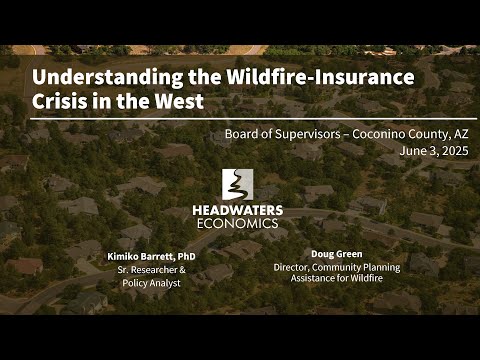
Coconino County supervisors, meeting as the Flood Control District board of directors, on Oct. 12 heard experts from Headwaters Economics outline how growing wildfire risk is tightening the homeowners insurance market and what local actions may help retain coverage.
The presentation, led by Dr. Kimiko "Kimmy" Barrett, wildfire researcher and policy analyst at Headwaters Economics, and Doug Green, wildfire specialist with Headwaters Economics, framed the problem as both technical and systemic: more frequent, hotter wildfires, greater numbers of structures in high-risk areas, and insurer responses that include rate increases, nonrenewals and market withdrawals. "Insurance is a price signal of the existing risk," Barrett said, noting that insurers and state regulators set coverage decisions based on pooled risk and affordability.
The briefing matters because Coconino County faces above-average exposure: presenters said the county ranks in the top 4% of U.S. counties for wildfire risk, with a locally cited figure that 98% of homes and buildings in the county are directly or indirectly exposed to wildfires. Barrett emphasized that nearly half of wildfire-related costs are borne at the local level and that these local burdens are one reason insurers are limiting coverage in high-risk areas.
Headwaters Economics explained three common causes of home ignition during wildfires—direct flame contact, radiant heat and embers—and stressed that embers cause the majority of structure losses in large conflagrations. "By far, the most common way we lose community is through embers," Green said, explaining embers can travel miles ahead of a fire and ignite many separate ignition sources in a community. He added that ember mitigation—reducing penetration points such as vents, combustible siding and nearby vegetation—is a scientifically supported, cost-effective way to reduce structure losses.
Presenters described community-level approaches that insurers look for when deciding whether to stay in a market. Barrett and Green listed five "ingredients" for successful local strategies: staffing and capacity to do parcel-level inspections and neighborhood mitigation, high-quality parcel-level data, clear communications with residents and stakeholders, collaborative public-private partnerships that include insurers and regulators, and funding (grants, subsidies, cost-share programs) to support mitigation. Barrett described existing programs intended to bridge the gap between household action and insurer acceptance, including Boulder County's Wildfire Partners home-certification program and the Insurance Institute for Business & Home Safety (IBHS) wildfire-prepared home certification.
Supervisors asked how the county can close the gap between homeowners who perform mitigation and insurers that still decline or raise coverage. Barrett said certification programs and data transparency—shared risk maps and inspection records—help create a common, verifiable standard that insurers can accept. She noted the state Department of Insurance and Financial Institutions (DIFI) has a resiliency mitigation council that will provide recommendations to the governor and that building insurer–county regulatory alignment takes time.
County officials emphasized this is a system-level problem requiring multi-jurisdictional action. Chair Horstman said the county's prior investments in forest restoration and partnerships with the U.S. Forest Service and the City of Flagstaff are part of a front-end mitigation strategy. Supervisors raised practical next steps: mapping high‑risk areas across the whole county, revisiting building codes and land-use policies, standing up parcel-level inspection and tracking systems, identifying funding sources to help homeowners retrofit existing homes, and convening insurers, regulators and community stakeholders.
The board took a procedural vote early in the session to resolve into the Flood Control District board of directors before the presentation; the motion passed by unanimous voice vote (individual roll-call tallies were not specified in the meeting record). The county said this is the first in a planned series of work sessions on wildfire insurance and resilience.
The experts cautioned there is no single "silver bullet." Green said community-level, neighborhood-scale mitigation combined with parcel-level actions provides the best chance of keeping insurers in a market: "If there is 1 vulnerability in that neighborhood, that can still cause the entire neighborhood to be leveled from fire." Barrett added that insurance is not a substitute for mitigation—it is post‑disaster financial transfer—and that communities must combine mitigation and financial tools to reduce long-term costs.
The session concluded with supervisors asking Headwaters Economics to return for future work sessions that will drill into certification pathways, data systems, potential funding models and coordination with the state Department of Insurance and Financial Institutions. The presenters offered ongoing technical assistance and said they will follow up with county staff on next steps.